Comparisons
Comparisons
Reviews
Reviews
Best Fractional Real Estate Platforms in 2026
Best Fractional Real Estate Platforms in 2026
Best Fractional Real Estate Platforms in 2026
We compared the seven major fractional real estate platforms on the things that actually matter, then ranked nothing. Here is why, and what to look at instead.
We compared the seven major fractional real estate platforms on the things that actually matter, then ranked nothing. Here is why, and what to look at instead.
We compared the seven major fractional real estate platforms on the things that actually matter, then ranked nothing. Here is why, and what to look at instead.

Youssef Kholeif
CMO, PSFnetwork
CMO, PSFnetwork
Published
Published
Published
•
•

TL;DR
The platform comparison everyone wants is the return ranking. It does not exist in any honest form. Vintages differ. Fee schedules differ. Property mixes differ. Skip the ranking. Match the platform to your situation: Fundrise for set-and-forget at $10, Ark7 or Arrived to pick the building at $100, psfnetwork for square-foot clarity, Lofty for daily on-chain liquidity, Mogul for curated commercial at $250.
The platform comparison everyone wants is the return ranking. It does not exist in any honest form. Vintages differ. Fee schedules differ. Property mixes differ. Skip the ranking. Match the platform to your situation: Fundrise for set-and-forget at $10, Ark7 or Arrived to pick the building at $100, psfnetwork for square-foot clarity, Lofty for daily on-chain liquidity, Mogul for curated commercial at $250.
We compared the major platforms on what actually shapes the investor experience: structure, accessibility, liquidity, and ownership model. Instead of crowning a winner, we map which platform fits which kind of investor.
The 60-second version
Ten dollars now buys a stake in a rented house. A few hundred dollars buys a share of an apartment building, and the purchase settles in about the time it takes to order lunch. Fractional investing has pulled real estate down from a five-figure commitment to something close to an impulse buy, and dozens of platforms now compete for that first small deposit.
That abundance creates a new problem. Search for the best fractional real estate platforms and every list names a different winner. The rankings rarely agree, because the platforms behind them are not truly comparable. They hold different assets, charge in different ways, and even calculate returns on their own terms.
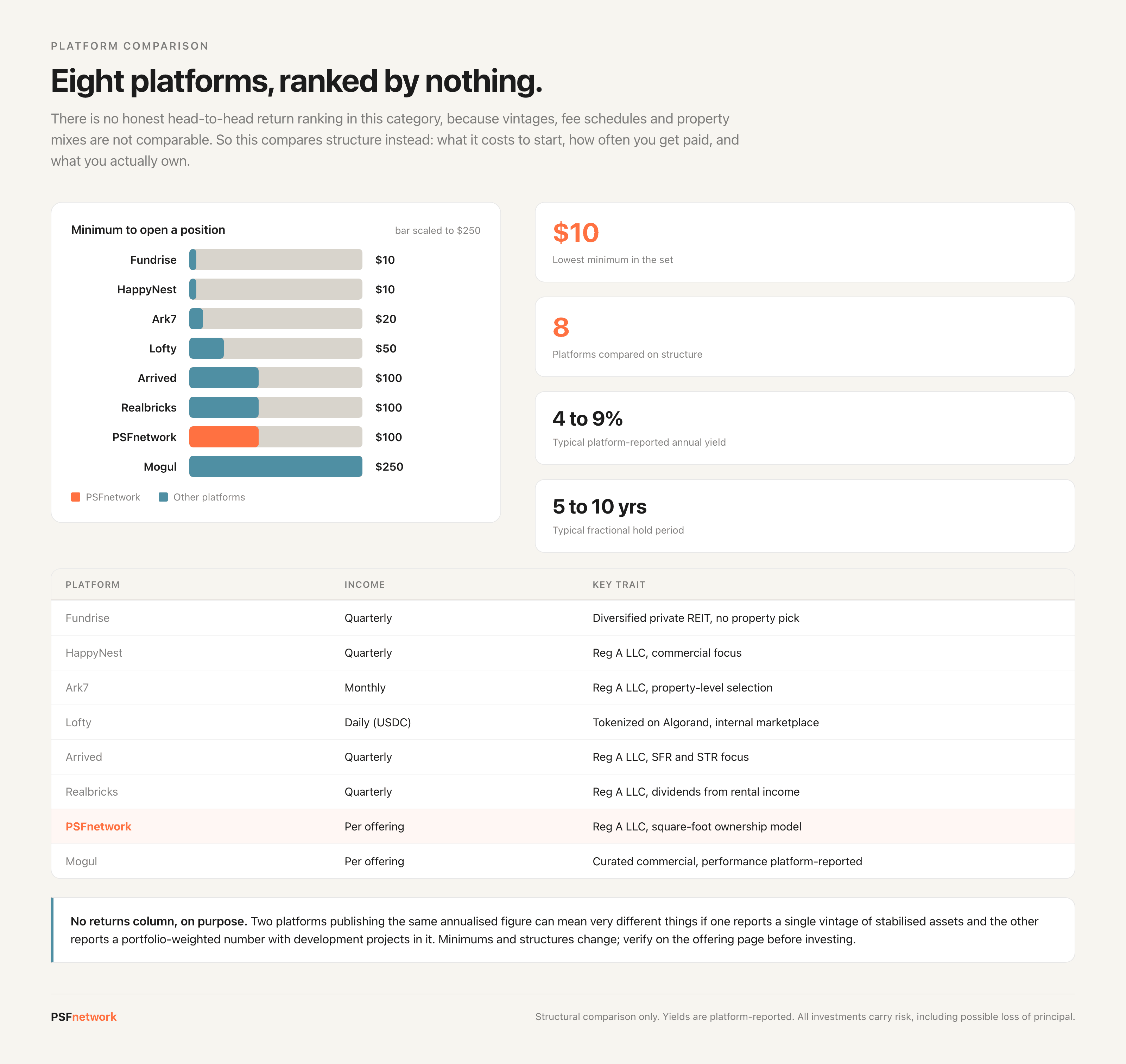
There is no universal winner here. The better question is which platform aligns with your goals, your timeline, and your tolerance for illiquidity. The table below is the fastest way to find yours.
The Comparison, at a Glance
Minimums and terms change often, so confirm current figures against each platform's offering documents before investing.
Platform | Regulation | Minimum | Income | Liquidity | Ownership |
Fundrise | Reg A (eREITs) | About $10 | Quarterly | Periodic redemptions | Pooled fund shares |
HappyNest | Reg A | About $10 | Quarterly | Redemption program (recently changed) | Pooled REIT shares |
Ark7 | Reg A | About $20/share | Monthly | SEC-registered secondary market | LLC shares, single property |
Arrived | Reg A | About $100 | Quarterly | Limited, multi-year holds | LLC shares, single property |
Realbricks | Reg A | Low entry | Quarterly | Platform dependent | Direct fractional shares |
Lofty | Reg A, tokenized | About $50 | Daily | 24/7 token marketplace | Blockchain tokens |
Mogul | Reg A, tokenized | About $250 | Monthly | Limited | Blockchain tokens |
PSFnetwork | Reg A | From $100 | Income oriented | Platform dependent | Per-square-foot, debt-free |
PSFnetwork is the debt-free option in this table. The properties carry no mortgage, so investor income is not reduced by debt service.
Why This Comparison Exists
By Sunday night, Marcus had eight browser tabs open, three half-finished spreadsheets, and less confidence than when he started. A physical therapist in Austin, he had set aside a single weekend to choose a fractional real estate platform for his first few thousand dollars. Three weekends later, he was still choosing.
His problem was not too little information. It was too much, and most of it conflicting. One article ranked Fundrise first. Another favored Ark7. A third put Lofty at the top. Every list sounded confident, and almost every list was published by the platform sitting at the top of it.
That is the structural catch in this category. A comparison written by a platform is not automatically wrong, but it carries an obvious bias, and the result is a market full of rankings and short on context.
A fair disclosure: we are PSFnetwork, which means we are not a neutral observer either. Even so, a comparison earns its keep only when it is willing to point out where a competing platform is the better fit. So this guide focuses on structure rather than rankings.
For Investors Seeking Diversified Exposure: Fundrise and HappyNest
Both platforms were built around accessibility. Fundrise starts at roughly $10 and offers diversified, REIT-style exposure across a large pool of residential assets, so investors hold a broad portfolio rather than selecting individual properties. HappyNest follows a similar accessibility-first philosophy with a low entry point and a commercial real estate focus.
For a first step into fractional real estate investing, this model is a low-cost way to learn how the asset class behaves. A $10 position is a starting point rather than a strategy, and building meaningful exposure still takes time and capital. Both distribute income quarterly and rely on periodic redemption windows rather than a live market, so read the current liquidity terms carefully.
For Investors Who Prefer Property Selection: Ark7 and Arrived
Some investors do not want a managed portfolio. They want to choose the actual property, and both platforms are built for that, though they approach it differently.
Ark7 offers one of the lowest entry points for property-level investing, with shares around $20, monthly distributions, and an SEC-registered secondary market after a holding period. That secondary market matters, because it gives investors an exit that does not depend solely on the platform reopening redemptions.
Arrived concentrates on single-family and short-term rental homes. Its straightforward experience and high-profile backing have made it one of the most visible names in the category. Holding periods run several years, so it suits investors comfortable leaving capital in place.
For Investors Focused on Rental Income: Realbricks
Realbricks centers on income-generating residential real estate through a Regulation A structure, with an emphasis on rental-income distributions and accessible fractional shares.
From a Realbricks review standpoint, the platform sits closer to traditional fractional models than to tokenized alternatives. Investors will tend to focus on property quality, the consistency of income distributions, and the specific liquidity terms rather than on novel ownership mechanics. It distributes dividends quarterly, alongside Fundrise and Arrived in cadence.
For Investors Who Want Tangible, Debt-Free Ownership: PSFnetwork
Most fractional platforms hand investors shares of an LLC. The structure is sound, but a block of shares is an abstraction, and abstractions are easy to misjudge. It is hard to picture what a given number of LLC units actually represents inside a real building.
PSFnetwork is built around a more tangible idea. Ownership is measured by the square foot and tied to a specific property, so investors can see exactly how much of a building they hold. The legal foundation is a Regulation A offering, which means non-accredited investors can participate and the same SEC reporting and EDGAR filings apply. What changes is the experience of ownership itself: legible, specific, and easy to reason with.
The properties also carry no mortgage, and that single choice has practical consequences. Rental income is not reduced by debt service, and the holdings are not exposed to the refinancing and rate pressure that has weighed on a number of leveraged real estate vehicles in recent years. Leverage can amplify returns, so this is a deliberate tradeoff, and for investors who value steady income over amplified upside, that tradeoff is the entire point.
For Investors Interested in Tokenized Real Estate: Lofty
Lofty represents ownership as blockchain tokens, with each property held in its own LLC and ownership recorded on-chain. Minimums start around $50, and the platform is known for distributing rental income daily, paid in a stablecoin, with tokens that can trade on a 24/7 marketplace.
For investors comfortable managing a crypto wallet and stablecoins, that offers unusually active liquidity and frequent income. For everyone else, the same features add operational complexity and a layer of regulatory and technological uncertainty. The tokenization is real, but the position is still a passive holder with no direct control over the property.
For Investors Who Prefer Curated Property Selection: Mogul
Mogul takes a more hands-on approach to selection than most platforms here. Rather than emphasizing broad diversification, it focuses on individually underwritten single-family rental properties that pass an internal screening process, with founders who highlight institutional backgrounds.
Minimums currently start around $250, and the positioning centers on curated deals, monthly income potential, and direct exposure to specific properties. Mogul also records ownership using blockchain tokens, so it shares some mechanics with Lofty even though its pitch is curation rather than active trading. The tradeoff is that you place greater trust in the platform's underwriting than in your own diversification. As with any newer platform, it is reasonable to ask how many properties have completed a full cycle before drawing conclusions about performance.
Understanding the Risks
Fractional real estate carries real risk, and the past two years have made that concrete. Several established platforms paused or restructured their redemption programs between late 2024 and 2026, which left some investors unable to access capital on the timeline they expected. Liquidity that looks generous in marketing can tighten quickly when conditions change.
Three risks deserve attention. The first is liquidity, since many offerings lock capital for years and redemption windows can be suspended. The second is valuation, because the net asset value of a fund or property is an estimate and can fall. The third is platform risk, as a young platform with few completed exits has not yet proven its model across a full cycle. If a platform cannot clearly identify its regulatory framework or produce the relevant SEC filings, treat that as a reason for caution and additional due diligence.
Lastly, most investors begin the search for the best fractional real estate platforms looking for a winner. The more useful question is what kind of investor each platform was built to serve.
Some platforms prioritize diversification and a low entry point. Others are designed around property-level selection, tokenized ownership, curated underwriting, or particular approaches to liquidity. Those structural differences tend to matter far more than any single platform-reported return figure, because returns, market conditions, and platform positioning varies, while the underlying mechanics are far more durable.
Before committing capital, read the offering documents, understand the fee schedule, study the liquidity terms, and evaluate the specific property rather than relying on platform-level marketing. The best fractional real estate platforms are not the ones at the top of a list. They are the ones whose structure, risk profile, and ownership model line up with how you actually want to invest.
We compared the major platforms on what actually shapes the investor experience: structure, accessibility, liquidity, and ownership model. Instead of crowning a winner, we map which platform fits which kind of investor.
The 60-second version
Ten dollars now buys a stake in a rented house. A few hundred dollars buys a share of an apartment building, and the purchase settles in about the time it takes to order lunch. Fractional investing has pulled real estate down from a five-figure commitment to something close to an impulse buy, and dozens of platforms now compete for that first small deposit.
That abundance creates a new problem. Search for the best fractional real estate platforms and every list names a different winner. The rankings rarely agree, because the platforms behind them are not truly comparable. They hold different assets, charge in different ways, and even calculate returns on their own terms.
There is no universal winner here. The better question is which platform aligns with your goals, your timeline, and your tolerance for illiquidity. The table below is the fastest way to find yours.
The Comparison, at a Glance
Minimums and terms change often, so confirm current figures against each platform's offering documents before investing.
Platform | Regulation | Minimum | Income | Liquidity | Ownership |
Fundrise | Reg A (eREITs) | About $10 | Quarterly | Periodic redemptions | Pooled fund shares |
HappyNest | Reg A | About $10 | Quarterly | Redemption program (recently changed) | Pooled REIT shares |
Ark7 | Reg A | About $20/share | Monthly | SEC-registered secondary market | LLC shares, single property |
Arrived | Reg A | About $100 | Quarterly | Limited, multi-year holds | LLC shares, single property |
Realbricks | Reg A | Low entry | Quarterly | Platform dependent | Direct fractional shares |
Lofty | Reg A, tokenized | About $50 | Daily | 24/7 token marketplace | Blockchain tokens |
Mogul | Reg A, tokenized | About $250 | Monthly | Limited | Blockchain tokens |
PSFnetwork | Reg A | From $100 | Income oriented | Platform dependent | Per-square-foot, debt-free |
PSFnetwork is the debt-free option in this table. The properties carry no mortgage, so investor income is not reduced by debt service.
Why This Comparison Exists
By Sunday night, Marcus had eight browser tabs open, three half-finished spreadsheets, and less confidence than when he started. A physical therapist in Austin, he had set aside a single weekend to choose a fractional real estate platform for his first few thousand dollars. Three weekends later, he was still choosing.
His problem was not too little information. It was too much, and most of it conflicting. One article ranked Fundrise first. Another favored Ark7. A third put Lofty at the top. Every list sounded confident, and almost every list was published by the platform sitting at the top of it.
That is the structural catch in this category. A comparison written by a platform is not automatically wrong, but it carries an obvious bias, and the result is a market full of rankings and short on context.
A fair disclosure: we are PSFnetwork, which means we are not a neutral observer either. Even so, a comparison earns its keep only when it is willing to point out where a competing platform is the better fit. So this guide focuses on structure rather than rankings.
For Investors Seeking Diversified Exposure: Fundrise and HappyNest
Both platforms were built around accessibility. Fundrise starts at roughly $10 and offers diversified, REIT-style exposure across a large pool of residential assets, so investors hold a broad portfolio rather than selecting individual properties. HappyNest follows a similar accessibility-first philosophy with a low entry point and a commercial real estate focus.
For a first step into fractional real estate investing, this model is a low-cost way to learn how the asset class behaves. A $10 position is a starting point rather than a strategy, and building meaningful exposure still takes time and capital. Both distribute income quarterly and rely on periodic redemption windows rather than a live market, so read the current liquidity terms carefully.
For Investors Who Prefer Property Selection: Ark7 and Arrived
Some investors do not want a managed portfolio. They want to choose the actual property, and both platforms are built for that, though they approach it differently.
Ark7 offers one of the lowest entry points for property-level investing, with shares around $20, monthly distributions, and an SEC-registered secondary market after a holding period. That secondary market matters, because it gives investors an exit that does not depend solely on the platform reopening redemptions.
Arrived concentrates on single-family and short-term rental homes. Its straightforward experience and high-profile backing have made it one of the most visible names in the category. Holding periods run several years, so it suits investors comfortable leaving capital in place.
For Investors Focused on Rental Income: Realbricks
Realbricks centers on income-generating residential real estate through a Regulation A structure, with an emphasis on rental-income distributions and accessible fractional shares.
From a Realbricks review standpoint, the platform sits closer to traditional fractional models than to tokenized alternatives. Investors will tend to focus on property quality, the consistency of income distributions, and the specific liquidity terms rather than on novel ownership mechanics. It distributes dividends quarterly, alongside Fundrise and Arrived in cadence.
For Investors Who Want Tangible, Debt-Free Ownership: PSFnetwork
Most fractional platforms hand investors shares of an LLC. The structure is sound, but a block of shares is an abstraction, and abstractions are easy to misjudge. It is hard to picture what a given number of LLC units actually represents inside a real building.
PSFnetwork is built around a more tangible idea. Ownership is measured by the square foot and tied to a specific property, so investors can see exactly how much of a building they hold. The legal foundation is a Regulation A offering, which means non-accredited investors can participate and the same SEC reporting and EDGAR filings apply. What changes is the experience of ownership itself: legible, specific, and easy to reason with.
The properties also carry no mortgage, and that single choice has practical consequences. Rental income is not reduced by debt service, and the holdings are not exposed to the refinancing and rate pressure that has weighed on a number of leveraged real estate vehicles in recent years. Leverage can amplify returns, so this is a deliberate tradeoff, and for investors who value steady income over amplified upside, that tradeoff is the entire point.
For Investors Interested in Tokenized Real Estate: Lofty
Lofty represents ownership as blockchain tokens, with each property held in its own LLC and ownership recorded on-chain. Minimums start around $50, and the platform is known for distributing rental income daily, paid in a stablecoin, with tokens that can trade on a 24/7 marketplace.
For investors comfortable managing a crypto wallet and stablecoins, that offers unusually active liquidity and frequent income. For everyone else, the same features add operational complexity and a layer of regulatory and technological uncertainty. The tokenization is real, but the position is still a passive holder with no direct control over the property.
For Investors Who Prefer Curated Property Selection: Mogul
Mogul takes a more hands-on approach to selection than most platforms here. Rather than emphasizing broad diversification, it focuses on individually underwritten single-family rental properties that pass an internal screening process, with founders who highlight institutional backgrounds.
Minimums currently start around $250, and the positioning centers on curated deals, monthly income potential, and direct exposure to specific properties. Mogul also records ownership using blockchain tokens, so it shares some mechanics with Lofty even though its pitch is curation rather than active trading. The tradeoff is that you place greater trust in the platform's underwriting than in your own diversification. As with any newer platform, it is reasonable to ask how many properties have completed a full cycle before drawing conclusions about performance.
Understanding the Risks
Fractional real estate carries real risk, and the past two years have made that concrete. Several established platforms paused or restructured their redemption programs between late 2024 and 2026, which left some investors unable to access capital on the timeline they expected. Liquidity that looks generous in marketing can tighten quickly when conditions change.
Three risks deserve attention. The first is liquidity, since many offerings lock capital for years and redemption windows can be suspended. The second is valuation, because the net asset value of a fund or property is an estimate and can fall. The third is platform risk, as a young platform with few completed exits has not yet proven its model across a full cycle. If a platform cannot clearly identify its regulatory framework or produce the relevant SEC filings, treat that as a reason for caution and additional due diligence.
Lastly, most investors begin the search for the best fractional real estate platforms looking for a winner. The more useful question is what kind of investor each platform was built to serve.
Some platforms prioritize diversification and a low entry point. Others are designed around property-level selection, tokenized ownership, curated underwriting, or particular approaches to liquidity. Those structural differences tend to matter far more than any single platform-reported return figure, because returns, market conditions, and platform positioning varies, while the underlying mechanics are far more durable.
Before committing capital, read the offering documents, understand the fee schedule, study the liquidity terms, and evaluate the specific property rather than relying on platform-level marketing. The best fractional real estate platforms are not the ones at the top of a list. They are the ones whose structure, risk profile, and ownership model line up with how you actually want to invest.
Sources
1. SEC Office of Investor Education (investor.gov), "Regulation A"
2. SEC Office of Investor Education (investor.gov), "Real Estate Investment Trusts (REITs)"
3. SEC EDGAR full-text search (for verifying any platform's offering filing)
4. Internal Revenue Service, "Partner's Instructions for Schedule K-1 (Form 1065)"
7. Realbricks
8. Lofty, "Best Platforms for Fractional Real Estate Investing"
9. Ark7
Youssef Kholeif
CMO, PSFnetwork
Disclaimer
This article is for educational purposes only and does not constitute financial, investment, legal, or tax advice. Investments involve risk, including potential loss of principal. Past performance does not guarantee future returns. Investments are offered through PSFnetwork MasterSeries LLC under Reg A. Please review the offering circular and consult a qualified financial advisor before making investment decisions.

Ready When You are
Start from square one
Browse fractional properties across US metros. No accreditation required.
Ready When You are
Start from square one
Browse fractional properties across US metros. No accreditation required.
Keep Reading




Important information
© 2026 PSFnetwork. All rights reserved.
Important information
© 2026 PSFnetwork. All rights reserved.