Fundamentals
Fundamentals
Comparisons
Comparisons
Reg A vs Reg D for Fractional Real Estate Investors (2026)
Reg A vs Reg D for Fractional Real Estate Investors (2026)
Reg A vs Reg D for Fractional Real Estate Investors (2026)
Reg A vs Reg D shapes who can invest, how much capital, and what disclosures you receive. Here is what each SEC framework means for fractional real estate.
Reg A vs Reg D shapes who can invest, how much capital, and what disclosures you receive. Here is what each SEC framework means for fractional real estate.
Reg A vs Reg D shapes who can invest, how much capital, and what disclosures you receive. Here is what each SEC framework means for fractional real estate.

Omar Elghazaly
CEO, PSFnetwork
CEO, PSFnetwork
Published
Published
Published
•
•

TL;DR
Most fractional real estate platforms operate under one of two SEC frameworks. Understanding the difference can help investors evaluate access, disclosures, and investment opportunities more effectively.
Most fractional real estate platforms operate under one of two SEC frameworks. Understanding the difference can help investors evaluate access, disclosures, and investment opportunities more effectively.
Quick Answer (60 seconds)
If you've ever wondered why one real estate platform lets you invest $100 while another asks for proof that you're an accredited investor, the answer usually comes down to a single decision: Reg A or Reg D.
These two SEC frameworks determine who can invest, how offerings are marketed, what disclosures investors receive, and how much ongoing reporting issuers must provide.
For most retail investors, Reg A is the framework they encounter most often. It allows participation from non-accredited investors and is commonly used by consumer-facing fractional real estate platforms.
Reg D operates differently. It is designed primarily for private offerings and accredited investors. In exchange for fewer public disclosure requirements and faster fundraising, access becomes more restricted.
Neither framework guarantees better investments or stronger returns. The difference is largely about access, transparency, and investor eligibility.
Quick Facts:
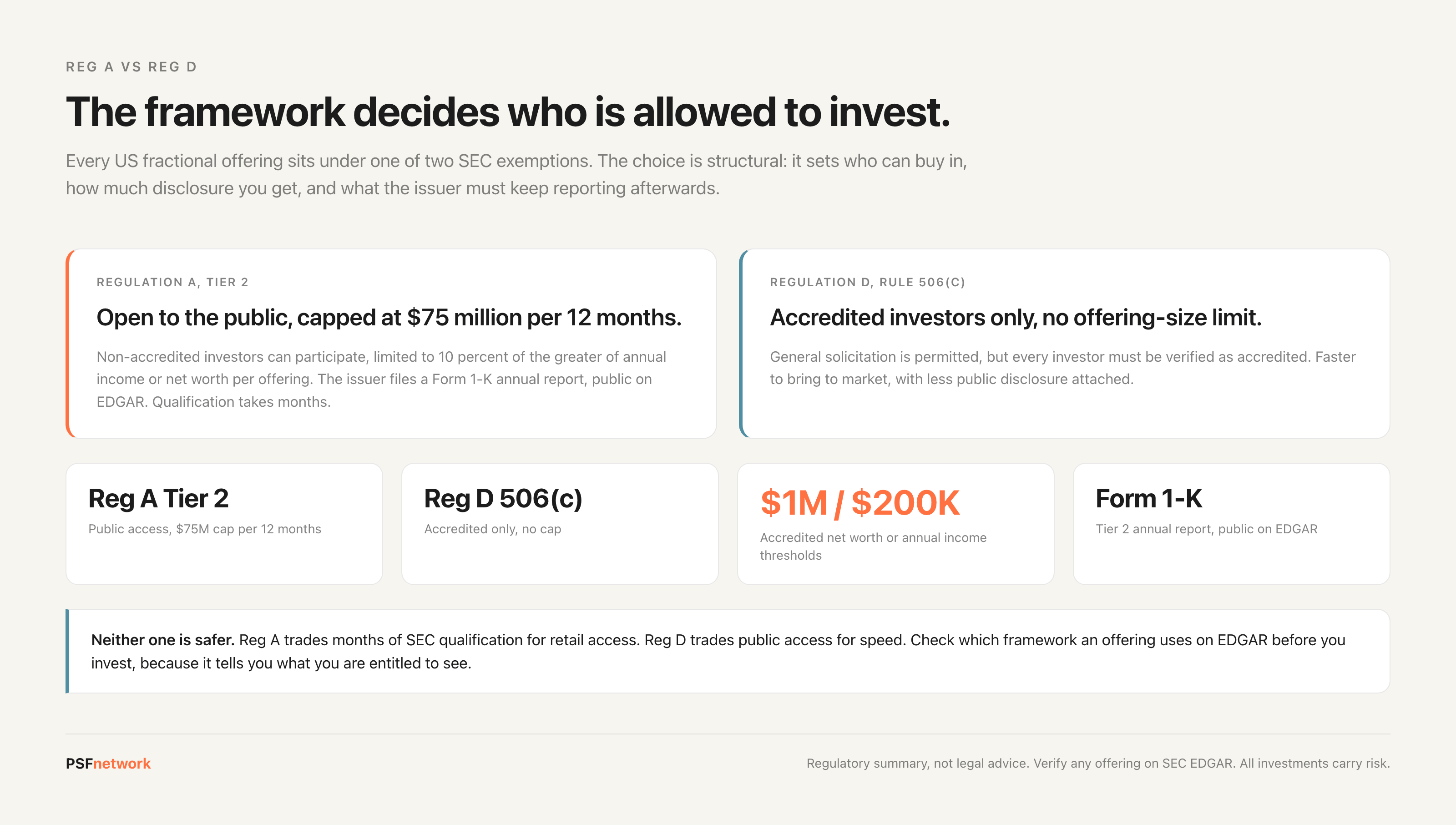
Reg A Tier 2 - Public access, $75M cap
Reg D 506(c) - Accredited only, no cap
$1M / $200K - Accredited net worth / income thresholds
Form 1-K - Tier 2 annual report (public on EDGAR)
Past performance is not indicative of future results. All real estate investments carry risk including loss of principal.
Why Investors Keep Running Into Reg A and Reg D?
Imagine finding two nearly identical real estate opportunities online. The first allows you to invest immediately with a few hundred dollars. The second asks whether you are an accredited investor. If you are not, the investment stops there.
For many investors, that feels arbitrary. The properties may look similar. The projected returns may even look similar. Yet one deal is open to almost anyone while the other is reserved for a much smaller group of investors.
The difference is rarely the property itself. It is usually the regulatory framework behind the offering.
Most fractional real estate platforms operate under either Reg A or Reg D. Both are SEC exemptions. Both are widely used. Both can be found across real estate crowdfunding and fractional ownership platforms.
What changes is who gets access, what information must be disclosed, and how the offering reaches investors in the first place.
Understanding those differences can save a surprising amount of confusion. It can also help investors evaluate offerings more effectively before focusing on projected yields, occupancy rates, or property appreciation.
In this guide, we'll break down Reg A vs Reg D from an investor's perspective, explain how each framework works, and show why the distinction matters when evaluating fractional real estate opportunities.
Reg A Explained From an Investor's Perspective
When investors hear "Reg A," they often assume it's simply another piece of securities-law jargon.
In reality, it has a direct impact on who can participate in an investment opportunity.
Reg A allows companies to raise money from the public, including non-accredited investors. That's one reason it has become the preferred framework for many consumer-facing fractional real estate platforms.
If you've invested in real estate online with a relatively small amount of capital, there's a good chance the offering was structured under Reg A.
The framework became significantly more useful after the JOBS Act and subsequent SEC rule changes expanded its capabilities. Today, most platforms operate under Reg A Tier 2 rather than Tier 1.
Reg A Tier 1
Tier 1 allows companies to raise up to $20 million within a rolling 12-month period.
Financial statements do not necessarily need to be audited. However, issuers must comply with securities reviews in each state where the offering is sold.
For companies operating nationally, that process can become burdensome. As a result, Tier 1 is relatively uncommon among larger fractional real estate platforms.
Reg A Tier 2
Tier 2 allows companies to raise up to $75 million within a rolling 12-month period.
In exchange, issuers face stricter reporting obligations.
Financial statements must be audited. Annual reports must be filed. Material events must be disclosed. Investors can review these filings through the SEC's EDGAR database.
For investors, this creates an important advantage.
Instead of relying entirely on marketing materials, you gain access to ongoing public disclosures that can help you evaluate the health of an offering over time.
This combination of retail accessibility and public reporting explains why many fractional real estate platforms, including PSFnetwork, operate under Reg A Tier 2.
Reg D Explained From an Investor's Perspective
If Reg A is designed to expand access, Reg D is designed to simplify capital raising.
Unlike Reg A, Reg D does not require an offering to go through a qualification process before accepting investments. This can make fundraising significantly faster for issuers.
The tradeoff is access.
Many Reg D offerings are restricted to accredited investors, meaning participation is limited to individuals who meet specific income, net-worth, or professional qualification requirements.
For that reason, Reg D is especially common in private real estate syndications, commercial real estate funds, and larger deal-by-deal investment platforms.
Within Reg D, investors will most often encounter two rules: 506(b) and 506(c).
Rule 506(b)
Rule 506(b) allows issuers to raise an unlimited amount of capital from accredited investors and a limited number of sophisticated non-accredited investors.
The catch is marketing.
Issuers cannot broadly advertise these offerings to the public. Participation generally requires an existing relationship between the investor and the sponsor.
Rule 506(c)
Rule 506(c) takes a different approach.
Issuers can publicly market the investment through websites, social media, webinars, conferences, and advertising campaigns.
However, every investor must be accredited.
More importantly, accredited status must be verified rather than simply self-reported.
This is why many investors encounter requests for financial documentation when participating in Reg D offerings.
The benefit for sponsors is broader marketing freedom. The tradeoff for investors is a more restrictive eligibility requirement.
Who Qualifies as an Accredited Investor?
The term "accredited investor" appears frequently in private-market investing, but many people misunderstand what it actually means.
Contrary to popular belief, accreditation is not a certification, license, or investment test. Instead, it is a legal classification defined by the SEC.
In most cases, an individual qualifies as an accredited investor if they meet one of two financial thresholds:
Net worth exceeding $1 million, excluding the value of a primary residence.
Annual income above $200,000 individually, or $300,000 jointly with a spouse or spousal equivalent, for the previous two years with a reasonable expectation of reaching the same level in the current year.
The SEC also recognizes certain professional credentials. Holders of licenses such as Series 7, Series 65, and Series 82 may qualify regardless of income or net worth.
Why does this matter?
Because many Reg D offerings are available only to accredited investors.
For sponsors, the logic is straightforward. Regulators assume investors meeting these thresholds have greater financial resources and are better positioned to evaluate private-market risks.
Whether that assumption is always correct is a separate debate. What matters in practice is that accreditation determines which opportunities investors can legally access.
One common misconception involves home equity.
Many investors assume that owning a valuable home automatically pushes them over the $1 million threshold. In most cases, it does not. The value of a primary residence is excluded from the net-worth calculation.
If you're uncertain about your status, it's worth confirming with the platform, a CPA, or a qualified attorney before investing.
Reg A Tier 2 vs Reg D 506(c): The Practical Differences
Most investors don't spend much time thinking about securities exemptions. What they notice are the practical consequences.
Can I invest?
What information will I receive?
How easy is it to evaluate the opportunity?
Those questions often reveal the difference between Reg A Tier 2 and Reg D 506(c) more clearly than the legal definitions.
Category | Reg A Tier 2 | Reg D 506(c) |
Investor Eligibility | Non-accredited investors allowed | Accredited investors only |
Offering Limit | Up to $75 million | No offering limit |
Marketing | Public marketing allowed | Public marketing allowed |
SEC Qualification | Required before launch | Not required |
Ongoing Reporting | Ongoing SEC reporting required | Typically limited after closing |
Public Filings | Offering documents and reports available on EDGAR | Form D filing only |
The biggest distinction for investors is transparency. Under Reg A Tier 2, offering documents and ongoing reports remain publicly available through EDGAR. Investors can continue monitoring disclosures long after the offering closes.
Reg D follows a different philosophy. The framework assumes accredited investors can perform their own due diligence with fewer public-reporting requirements. As a result, many disclosures remain private between the sponsor and participating investors.
Neither approach guarantees a better investment outcome. A strong deal can exist under either framework. A weak deal can as well.
The framework tells you how the investment is structured. It does not tell you whether the investment itself is attractive.
What Investor Protections Come With Each Framework?
Investor protections often become the deciding factor when comparing Reg A and Reg D.
This is where the differences become more meaningful. Under Reg A Tier 2, issuers must file an offering circular with the SEC before accepting investments. Financial statements are audited. Material information must be disclosed. Ongoing reporting continues after the offering launches.
Investors can review annual reports, semiannual reports, and material-event filings through EDGAR. That creates a public record.
For many investors, especially those new to private markets, that additional transparency provides a level of comfort.
Reg D works differently. The issuer typically provides information through a private placement memorandum, often called a PPM. These documents can still be detailed and comprehensive, but they are generally distributed only to prospective investors rather than made publicly available.
As a result, evaluating a Reg D opportunity often requires a greater degree of independent due diligence.
This is one reason many retail-focused fractional real estate platforms gravitate toward Reg A. The framework aligns more naturally with broad investor participation and public disclosure.
Which Framework Do Fractional Real Estate Platforms Typically Use?
A simple rule of thumb often works surprisingly well. If a platform advertises that almost anyone can invest, it is probably operating under Reg A Tier 2. If a platform asks you to verify accredited-investor status before participating, it is probably using Reg D.
Many well-known consumer-facing fractional real estate platforms operate under Reg A structures because accessibility is central to their business model. Platforms such as Fundrise, Arrived, Ark7, Realbricks, and PSFnetwork use Reg A offerings to make real estate investing available to a broader audience.
By contrast, many commercial real estate syndications and larger private offerings use Reg D. These investments often target accredited investors seeking access to larger deals, institutional-style opportunities, or specialized commercial projects.
Some platforms operate under both frameworks. A company may offer retail-focused investments under Reg A while simultaneously launching accredited-only offerings under Reg D.
For that reason, investors should evaluate each offering individually rather than assuming every investment on a platform follows the same structure.
How Does This Apply to PSFnetwork?
PSFnetwork operates under Reg A Tier 2. That choice aligns with the platform's broader goal of making fractional real estate investing accessible to a wider range of investors rather than limiting participation to accredited individuals.
From an investor perspective, the regulatory framework affects far more than eligibility. It also determines what information is available before and after an investment is made.
Because PSFnetwork offerings are qualified under Reg A Tier 2, investors can review offering circulars, ongoing filings, and other disclosures through EDGAR. The platform's per-square-foot ownership model is separate from the regulatory framework itself.
In other words, the ownership structure may change how exposure is presented to investors, but it does not change the underlying SEC exemption being used.
The more important takeaway is that Reg A Tier 2 provides the foundation that allows non-accredited investors to participate while maintaining ongoing public disclosure requirements.
Which one is suitable for you?
The debate around Reg A vs Reg D is often framed as a regulatory discussion, but for investors, the implications are much more practical.
These frameworks determine who can participate, how offerings are disclosed, and what information remains available after an investment is made.
Reg A generally prioritizes accessibility and transparency. Reg D prioritizes fundraising flexibility and private-market efficiency. Neither framework automatically produces better investments, and neither guarantees stronger outcomes.
What matters most is understanding the structure before evaluating the opportunity itself. A strong investment thesis, experienced management team, sensible fee structure, and quality underlying asset will usually have a greater impact on long-term results than the exemption listed on the cover page of an offering document.
Still, understanding the framework provides valuable context. It helps investors ask better questions, perform more effective due diligence, and make more informed decisions before committing capital.
Before investing in any fractional real estate opportunity, take a moment to identify whether the offering operates under Reg A or Reg D. Then review the relevant documents, understand the risks, and evaluate the investment on its own merits.
Sources
SEC, "Reg A", https://www.sec.gov/resources-small-businesses/exempt-offerings/regulation.
SEC, "Private Placements - Rule 506(b)", https://www.sec.gov/resources-small-businesses/exempt-offerings/private-placements-rule-506b.
SEC, "General Solicitation - Rule 506(c)", https://www.sec.gov/resources-small-businesses/exempt-offerings/general-solicitation-rule-506c.
SEC, "Assessing Accredited Investors under Reg D", https://www.sec.gov/resources-small-businesses/capital-raising-building-blocks/assessing-accredited-investors-under-regulation-d.
SEC, "Accredited Investors", https://www.sec.gov/resources-small-businesses/capital-raising-building-blocks/accredited-investors.
SEC, "Accredited Investor Net Worth Standard", https://www.sec.gov/resources-small-businesses/small-business-compliance-guides/accredited-investor-net-worth-standard.
SEC, "Rule 506 of Reg D" (Investor.gov), https://www.investor.gov/introduction-investing/investing-basics/glossary/rule-506-regulation-d.
SEC, "Reg A - Updated Investor Bulletin" (Investor.gov), https://www.investor.gov/introduction-investing/general-resources/news-alerts/alerts-bulletins/investor-bulletins/updated-1.
EDGAR full-text search, https://efts.sec.gov.
Quick Answer (60 seconds)
If you've ever wondered why one real estate platform lets you invest $100 while another asks for proof that you're an accredited investor, the answer usually comes down to a single decision: Reg A or Reg D.
These two SEC frameworks determine who can invest, how offerings are marketed, what disclosures investors receive, and how much ongoing reporting issuers must provide.
For most retail investors, Reg A is the framework they encounter most often. It allows participation from non-accredited investors and is commonly used by consumer-facing fractional real estate platforms.
Reg D operates differently. It is designed primarily for private offerings and accredited investors. In exchange for fewer public disclosure requirements and faster fundraising, access becomes more restricted.
Neither framework guarantees better investments or stronger returns. The difference is largely about access, transparency, and investor eligibility.
Quick Facts:
Reg A Tier 2 - Public access, $75M cap
Reg D 506(c) - Accredited only, no cap
$1M / $200K - Accredited net worth / income thresholds
Form 1-K - Tier 2 annual report (public on EDGAR)
Past performance is not indicative of future results. All real estate investments carry risk including loss of principal.
Why Investors Keep Running Into Reg A and Reg D?
Imagine finding two nearly identical real estate opportunities online. The first allows you to invest immediately with a few hundred dollars. The second asks whether you are an accredited investor. If you are not, the investment stops there.
For many investors, that feels arbitrary. The properties may look similar. The projected returns may even look similar. Yet one deal is open to almost anyone while the other is reserved for a much smaller group of investors.
The difference is rarely the property itself. It is usually the regulatory framework behind the offering.
Most fractional real estate platforms operate under either Reg A or Reg D. Both are SEC exemptions. Both are widely used. Both can be found across real estate crowdfunding and fractional ownership platforms.
What changes is who gets access, what information must be disclosed, and how the offering reaches investors in the first place.
Understanding those differences can save a surprising amount of confusion. It can also help investors evaluate offerings more effectively before focusing on projected yields, occupancy rates, or property appreciation.
In this guide, we'll break down Reg A vs Reg D from an investor's perspective, explain how each framework works, and show why the distinction matters when evaluating fractional real estate opportunities.
Reg A Explained From an Investor's Perspective
When investors hear "Reg A," they often assume it's simply another piece of securities-law jargon.
In reality, it has a direct impact on who can participate in an investment opportunity.
Reg A allows companies to raise money from the public, including non-accredited investors. That's one reason it has become the preferred framework for many consumer-facing fractional real estate platforms.
If you've invested in real estate online with a relatively small amount of capital, there's a good chance the offering was structured under Reg A.
The framework became significantly more useful after the JOBS Act and subsequent SEC rule changes expanded its capabilities. Today, most platforms operate under Reg A Tier 2 rather than Tier 1.
Reg A Tier 1
Tier 1 allows companies to raise up to $20 million within a rolling 12-month period.
Financial statements do not necessarily need to be audited. However, issuers must comply with securities reviews in each state where the offering is sold.
For companies operating nationally, that process can become burdensome. As a result, Tier 1 is relatively uncommon among larger fractional real estate platforms.
Reg A Tier 2
Tier 2 allows companies to raise up to $75 million within a rolling 12-month period.
In exchange, issuers face stricter reporting obligations.
Financial statements must be audited. Annual reports must be filed. Material events must be disclosed. Investors can review these filings through the SEC's EDGAR database.
For investors, this creates an important advantage.
Instead of relying entirely on marketing materials, you gain access to ongoing public disclosures that can help you evaluate the health of an offering over time.
This combination of retail accessibility and public reporting explains why many fractional real estate platforms, including PSFnetwork, operate under Reg A Tier 2.
Reg D Explained From an Investor's Perspective
If Reg A is designed to expand access, Reg D is designed to simplify capital raising.
Unlike Reg A, Reg D does not require an offering to go through a qualification process before accepting investments. This can make fundraising significantly faster for issuers.
The tradeoff is access.
Many Reg D offerings are restricted to accredited investors, meaning participation is limited to individuals who meet specific income, net-worth, or professional qualification requirements.
For that reason, Reg D is especially common in private real estate syndications, commercial real estate funds, and larger deal-by-deal investment platforms.
Within Reg D, investors will most often encounter two rules: 506(b) and 506(c).
Rule 506(b)
Rule 506(b) allows issuers to raise an unlimited amount of capital from accredited investors and a limited number of sophisticated non-accredited investors.
The catch is marketing.
Issuers cannot broadly advertise these offerings to the public. Participation generally requires an existing relationship between the investor and the sponsor.
Rule 506(c)
Rule 506(c) takes a different approach.
Issuers can publicly market the investment through websites, social media, webinars, conferences, and advertising campaigns.
However, every investor must be accredited.
More importantly, accredited status must be verified rather than simply self-reported.
This is why many investors encounter requests for financial documentation when participating in Reg D offerings.
The benefit for sponsors is broader marketing freedom. The tradeoff for investors is a more restrictive eligibility requirement.
Who Qualifies as an Accredited Investor?
The term "accredited investor" appears frequently in private-market investing, but many people misunderstand what it actually means.
Contrary to popular belief, accreditation is not a certification, license, or investment test. Instead, it is a legal classification defined by the SEC.
In most cases, an individual qualifies as an accredited investor if they meet one of two financial thresholds:
Net worth exceeding $1 million, excluding the value of a primary residence.
Annual income above $200,000 individually, or $300,000 jointly with a spouse or spousal equivalent, for the previous two years with a reasonable expectation of reaching the same level in the current year.
The SEC also recognizes certain professional credentials. Holders of licenses such as Series 7, Series 65, and Series 82 may qualify regardless of income or net worth.
Why does this matter?
Because many Reg D offerings are available only to accredited investors.
For sponsors, the logic is straightforward. Regulators assume investors meeting these thresholds have greater financial resources and are better positioned to evaluate private-market risks.
Whether that assumption is always correct is a separate debate. What matters in practice is that accreditation determines which opportunities investors can legally access.
One common misconception involves home equity.
Many investors assume that owning a valuable home automatically pushes them over the $1 million threshold. In most cases, it does not. The value of a primary residence is excluded from the net-worth calculation.
If you're uncertain about your status, it's worth confirming with the platform, a CPA, or a qualified attorney before investing.
Reg A Tier 2 vs Reg D 506(c): The Practical Differences
Most investors don't spend much time thinking about securities exemptions. What they notice are the practical consequences.
Can I invest?
What information will I receive?
How easy is it to evaluate the opportunity?
Those questions often reveal the difference between Reg A Tier 2 and Reg D 506(c) more clearly than the legal definitions.
Category | Reg A Tier 2 | Reg D 506(c) |
Investor Eligibility | Non-accredited investors allowed | Accredited investors only |
Offering Limit | Up to $75 million | No offering limit |
Marketing | Public marketing allowed | Public marketing allowed |
SEC Qualification | Required before launch | Not required |
Ongoing Reporting | Ongoing SEC reporting required | Typically limited after closing |
Public Filings | Offering documents and reports available on EDGAR | Form D filing only |
The biggest distinction for investors is transparency. Under Reg A Tier 2, offering documents and ongoing reports remain publicly available through EDGAR. Investors can continue monitoring disclosures long after the offering closes.
Reg D follows a different philosophy. The framework assumes accredited investors can perform their own due diligence with fewer public-reporting requirements. As a result, many disclosures remain private between the sponsor and participating investors.
Neither approach guarantees a better investment outcome. A strong deal can exist under either framework. A weak deal can as well.
The framework tells you how the investment is structured. It does not tell you whether the investment itself is attractive.
What Investor Protections Come With Each Framework?
Investor protections often become the deciding factor when comparing Reg A and Reg D.
This is where the differences become more meaningful. Under Reg A Tier 2, issuers must file an offering circular with the SEC before accepting investments. Financial statements are audited. Material information must be disclosed. Ongoing reporting continues after the offering launches.
Investors can review annual reports, semiannual reports, and material-event filings through EDGAR. That creates a public record.
For many investors, especially those new to private markets, that additional transparency provides a level of comfort.
Reg D works differently. The issuer typically provides information through a private placement memorandum, often called a PPM. These documents can still be detailed and comprehensive, but they are generally distributed only to prospective investors rather than made publicly available.
As a result, evaluating a Reg D opportunity often requires a greater degree of independent due diligence.
This is one reason many retail-focused fractional real estate platforms gravitate toward Reg A. The framework aligns more naturally with broad investor participation and public disclosure.
Which Framework Do Fractional Real Estate Platforms Typically Use?
A simple rule of thumb often works surprisingly well. If a platform advertises that almost anyone can invest, it is probably operating under Reg A Tier 2. If a platform asks you to verify accredited-investor status before participating, it is probably using Reg D.
Many well-known consumer-facing fractional real estate platforms operate under Reg A structures because accessibility is central to their business model. Platforms such as Fundrise, Arrived, Ark7, Realbricks, and PSFnetwork use Reg A offerings to make real estate investing available to a broader audience.
By contrast, many commercial real estate syndications and larger private offerings use Reg D. These investments often target accredited investors seeking access to larger deals, institutional-style opportunities, or specialized commercial projects.
Some platforms operate under both frameworks. A company may offer retail-focused investments under Reg A while simultaneously launching accredited-only offerings under Reg D.
For that reason, investors should evaluate each offering individually rather than assuming every investment on a platform follows the same structure.
How Does This Apply to PSFnetwork?
PSFnetwork operates under Reg A Tier 2. That choice aligns with the platform's broader goal of making fractional real estate investing accessible to a wider range of investors rather than limiting participation to accredited individuals.
From an investor perspective, the regulatory framework affects far more than eligibility. It also determines what information is available before and after an investment is made.
Because PSFnetwork offerings are qualified under Reg A Tier 2, investors can review offering circulars, ongoing filings, and other disclosures through EDGAR. The platform's per-square-foot ownership model is separate from the regulatory framework itself.
In other words, the ownership structure may change how exposure is presented to investors, but it does not change the underlying SEC exemption being used.
The more important takeaway is that Reg A Tier 2 provides the foundation that allows non-accredited investors to participate while maintaining ongoing public disclosure requirements.
Which one is suitable for you?
The debate around Reg A vs Reg D is often framed as a regulatory discussion, but for investors, the implications are much more practical.
These frameworks determine who can participate, how offerings are disclosed, and what information remains available after an investment is made.
Reg A generally prioritizes accessibility and transparency. Reg D prioritizes fundraising flexibility and private-market efficiency. Neither framework automatically produces better investments, and neither guarantees stronger outcomes.
What matters most is understanding the structure before evaluating the opportunity itself. A strong investment thesis, experienced management team, sensible fee structure, and quality underlying asset will usually have a greater impact on long-term results than the exemption listed on the cover page of an offering document.
Still, understanding the framework provides valuable context. It helps investors ask better questions, perform more effective due diligence, and make more informed decisions before committing capital.
Before investing in any fractional real estate opportunity, take a moment to identify whether the offering operates under Reg A or Reg D. Then review the relevant documents, understand the risks, and evaluate the investment on its own merits.
Sources
SEC, "Reg A", https://www.sec.gov/resources-small-businesses/exempt-offerings/regulation.
SEC, "Private Placements - Rule 506(b)", https://www.sec.gov/resources-small-businesses/exempt-offerings/private-placements-rule-506b.
SEC, "General Solicitation - Rule 506(c)", https://www.sec.gov/resources-small-businesses/exempt-offerings/general-solicitation-rule-506c.
SEC, "Assessing Accredited Investors under Reg D", https://www.sec.gov/resources-small-businesses/capital-raising-building-blocks/assessing-accredited-investors-under-regulation-d.
SEC, "Accredited Investors", https://www.sec.gov/resources-small-businesses/capital-raising-building-blocks/accredited-investors.
SEC, "Accredited Investor Net Worth Standard", https://www.sec.gov/resources-small-businesses/small-business-compliance-guides/accredited-investor-net-worth-standard.
SEC, "Rule 506 of Reg D" (Investor.gov), https://www.investor.gov/introduction-investing/investing-basics/glossary/rule-506-regulation-d.
SEC, "Reg A - Updated Investor Bulletin" (Investor.gov), https://www.investor.gov/introduction-investing/general-resources/news-alerts/alerts-bulletins/investor-bulletins/updated-1.
EDGAR full-text search, https://efts.sec.gov.
Disclaimer
This article is for educational purposes only and does not constitute financial, investment, legal, or tax advice. Investments involve risk, including potential loss of principal. Past performance does not guarantee future returns. Investments are offered through PSFnetwork MasterSeries LLC under Reg A. Please review the offering circular and consult a qualified financial advisor before making investment decisions.

Ready When You are
Start from square one
Browse fractional properties across US metros. No accreditation required.
Ready When You are
Start from square one
Browse fractional properties across US metros. No accreditation required.
Keep Reading





Important information
© 2026 PSFnetwork. All rights reserved.
Important information
© 2026 PSFnetwork. All rights reserved.