Fundamentals
Fundamentals
What Is Fractional Real Estate Investing? The 2026 Guide
What Is Fractional Real Estate Investing? The 2026 Guide
What Is Fractional Real Estate Investing? The 2026 Guide
Own a piece of a rental property for as little as $20, without becoming a landlord. Here is how fractional real estate investing works, who it is for, and what to watch out for.
Own a piece of a rental property for as little as $20, without becoming a landlord. Here is how fractional real estate investing works, who it is for, and what to watch out for.
Own a piece of a rental property for as little as $20, without becoming a landlord. Here is how fractional real estate investing works, who it is for, and what to watch out for.

Omar Elghazaly
CEO, PSFnetwork
CEO, PSFnetwork
Published
Published
Published
•
•

TL;DR
Fractional real estate investing lets multiple investors co-own a single rental property by purchasing shares of the legal entity that holds the property, typically an LLC. Each investor receives a proportional share of rental income and any appreciation when the property is sold. Platforms handle property management. A single share on some regulated US platforms (such as Ark7) costs as little as $20; a meaningful position typically requires aggregating multiple shares. All such investments carry real risk, including the loss of principal, and returns are not guaranteed.
Fractional real estate investing lets multiple investors co-own a single rental property by purchasing shares of the legal entity that holds the property, typically an LLC. Each investor receives a proportional share of rental income and any appreciation when the property is sold. Platforms handle property management. A single share on some regulated US platforms (such as Ark7) costs as little as $20; a meaningful position typically requires aggregating multiple shares. All such investments carry real risk, including the loss of principal, and returns are not guaranteed.
Fractional real estate investing allows multiple individuals to purchase shares of a single property. Here is a complete guide to how the market works and how you can participate in 2026.
The fractional real estate market is projected to reach 19.4 billion dollars by 2033, according to Custom Market Insights. That represents a 21 percent compound annual growth rate from its baseline in 2024. The capital flowing into this sector highlights a shift in how individuals approach property ownership. Buying a whole building requires massive upfront capital, financing approvals, and a willingness to handle repairs. Splitting a property into smaller shares removes those barriers, opening the asset class to a much wider pool of participants.
Quick Answer (60 seconds)
Quick answer: Fractional real estate investing allows multiple investors to buy shares of a single property, sharing the costs and the potential income. A platform or sponsor handles the operations, maintenance, and tenant management. You provide the capital and collect a proportional share of any distributions, without taking on a full mortgage or landlord duties.
Stat cards:
The tokenized fractional real estate market is projected to grow to 19.4 billion dollars by 2033, per Custom Market Insights.
Regulation A Tier 2 lets a company raise up to 75 million dollars per rolling 12 months, according to the SEC.
Regulation Crowdfunding allows a company to raise up to 5 million dollars per 12 months, per the SEC.
All real estate investments carry risk including loss of principal.
How Traditional Real Estate Ownership Works (and Why It Stops Most People)
Traditional real estate ownership is a straightforward concept with heavy practical burdens. A single buyer purchases an entire property. That buyer takes on the full responsibility of the down payment, the mortgage, and the ongoing maintenance.
Why is the traditional model difficult for retail investors?
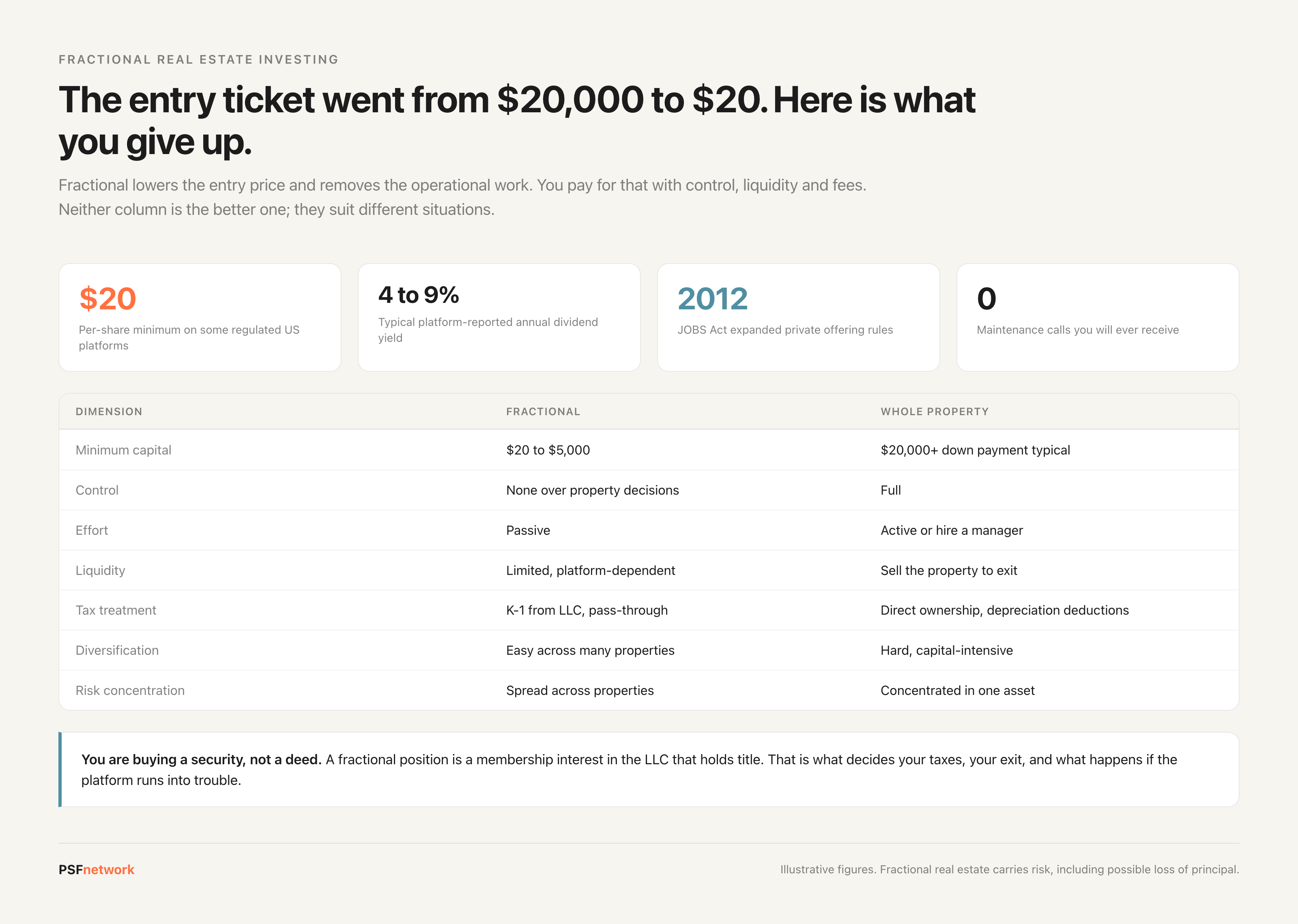
The primary barrier is capital. A standard commercial or investment property loan typically requires a down payment of 20 to 30 percent. On a one million dollar asset, the buyer needs up to 300,000 dollars in cash just to close the deal.
Beyond the initial capital, the traditional model demands active labor. The owner must find tenants, draft leases, collect rent, and answer repair calls. This active management role turns a passive investment into a second job. When a roof leaks or a tenant vacates a unit, the owner bears the full financial and operational cost.
Furthermore, traditional real estate concentrates risk. Tying up hundreds of thousands of dollars in a single building leaves the investor vulnerable to local market shifts or a single bad tenant. If the property sits empty, the mortgage payment is still due. These factors combined keep many prospective investors out of the direct real estate market entirely.
What Fractional Real Estate Investing Actually Is
Fractional real estate investing changes the mechanics of ownership by dividing a high-value asset into smaller, more accessible pieces.
How does the fractional ownership structure operate?
In a fractional model, a company or sponsor identifies and acquires a property. Instead of keeping the entire asset, the sponsor splits the ownership into shares and offers them to multiple investors. Each investor buys a percentage of the property.
Because the investors only own a fraction of the building, they only pay a fraction of the cost. The sponsor or platform acts as the manager. They handle the tenant screening, property maintenance, rent collection, and legal compliance. In exchange for the investment, shareholders receive a proportional cut of any rental income generated by the property, usually paid out as regular distributions.
This structure allows individuals to gain exposure to real estate price movements and rental yields without taking on the active duties of a landlord. Returns are platform-reported and may vary, but the operational distance remains constant.
Types of Fractional Real Estate Investing
Not all fractional investments are structured the same way. The market offers several distinct models, each with different regulatory rules and investor requirements.
What is real estate crowdfunding?
Real estate crowdfunding pools money from numerous online investors to fund a specific project or development. These offerings often utilize Regulation Crowdfunding. Under this SEC framework, companies can raise up to 5 million dollars per 12 months. This model is open to non-accredited investors, though individual investment limits apply based on income and net worth. Crowdfunding deals often focus on short-term developments or specific value-add projects.
What are private syndications?
A syndication is a partnership between active sponsors and passive investors for a large commercial real estate deal. These often operate under Regulation D 506(c). This SEC exemption allows the sponsor to advertise the deal publicly, but the investment is generally restricted to accredited investors only. Accredited status requires an annual income above 200,000 dollars or a net worth above 1 million dollars, excluding a primary residence. Syndications typically require high minimum investments, often starting at 50,000 dollars.
What are Regulation A fractional platforms?
Regulation A is an SEC framework designed to help companies raise capital from the public. Tier 1 allows raises up to 20 million dollars, while Tier 2 allows up to 75 million dollars per rolling 12 months. Fractional platforms using Regulation A can offer shares to both accredited and non-accredited investors. These offerings require the company to file extensive disclosures with the SEC, giving retail investors a transparent look at the property financials before they commit capital.
How PSFnetwork's Per-Square-Foot Model Works
PSFnetwork takes a specific approach to fractional real estate investing by measuring ownership per square foot.
How does the per-square-foot model function?
On the PSFnetwork platform, investors do not just buy a generic share of a fund. They purchase a specific number of square feet in a specific, identifiable property. If a retail building generates income, the investor receives distributions based directly on the square footage they own.
What makes the PSFnetwork approach distinct?
Three core elements define the PSFnetwork structure.
First, the platform utilizes Regulation A. This regulatory path ensures that both accredited and non-accredited investors can participate legally, with full SEC-filed offering circulars available for review.
Second, the properties offered on PSFnetwork are mortgage-free. By eliminating debt from the asset, the platform removes the risk of foreclosure due to missed loan payments. The lack of leverage means distributions are generated strictly from property income minus operating expenses, without a bank taking a cut for interest.
Third, PSFnetwork properties are strictly income-oriented. The primary goal is to generate rental yield for investors. Furthermore, the platform maintains a strict focus on the investment itself. PSFnetwork is not a community forum or a social dialogue space. The platform exists solely to facilitate per-square-foot property investment and manage the distributions.
Benefits of Fractional Investing vs. Traditional Ownership
When comparing fractional platforms to buying a whole property, several key advantages emerge for the retail investor.
Lower capital requirements
Instead of saving 100,000 dollars for a commercial down payment, investors can enter the fractional market with significantly less. Many platforms allow initial investments of a few hundred or a few thousand dollars. This lower barrier allows individuals to start building a real estate portfolio earlier in their financial journey.
Passive management
Fractional investing removes the midnight repair calls. The platform or a hired property management company handles the toilets, the tenants, and the trash. The investor's only job is to research the offering upfront, allocate capital, and monitor the performance.
Improved diversification
With a traditional purchase, an investor's capital is locked in a single location. If the local economy falters, the entire investment suffers. Fractional investing allows a buyer to spread 50,000 dollars across ten different properties in ten different cities, mitigating the impact of any single vacancy.
What to Look for in a Fractional Real Estate Platform
Choosing the right platform is just as important as choosing the right property. Investors should evaluate platforms based on transparency, fees, and regulatory compliance.
How should investors evaluate platform fees?
Every platform charges fees to cover acquisition, management, and administrative costs. Investors must read the offering circular to find these numbers. Look for clear, predictable fee structures. If a platform hides its management costs or takes an unusually large cut of the rental income before distributing it to investors, that is a red flag.
Why does regulatory compliance matter?
Always verify the SEC framework the platform uses. Platforms operating under Regulation A or Regulation Crowdfunding are subject to specific disclosure requirements. You should be able to look up the company on the SEC's EDGAR database. Platforms that skirt regulatory registration pose a massive risk to investor capital.
How important is the asset debt structure?
Review the leverage on the properties. High debt can amplify returns on invested equity (positive leverage), but it also can increase potential returns, but it also heavily increases risk. If property values fall or tenants stop paying rent, a highly leveraged property can be lost to the bank. Mortgage-free platforms eliminate this specific financing risk, offering a more defensive posture in volatile markets.
Is fractional real estate right for you?
Fractional real estate investing has fundamentally altered who can access the property market. By dividing large assets into smaller, affordable shares, this model eliminates the need for massive down payments and active landlord duties. The market growth expected by 2033 reflects a deep consumer demand for passive, asset-backed income.
Different platforms offer different paths, from crowdfunded developments to private accredited syndications. Platforms utilizing Regulation A provide a regulated, transparent option that remains accessible to the everyday retail investor. The core benefit across all these models is the ability to diversify capital across multiple properties without ever answering a tenant complaint.
However, careful due diligence remains critical. Investors must evaluate the fee structures, read the SEC offering circulars, and understand the debt levels on the underlying properties. Passive management does not mean a lack of risk.
For those looking to build property exposure, fractional models offer a streamlined, modern approach. By treating real estate as a scalable asset rather than a full-time job, investors can construct portfolios that align with their financial goals and their available time.
PSFnetwork offers fractional real estate measured per square foot and tied to a specific property. Offerings are structured under Regulation A, feature mortgage-free, income-oriented assets, and are open to both accredited and non-accredited investors. Review the offering documents before investing.
Sources
Custom Market Insights, via Binaryx: https://binaryx.com/blog/unlocking-high-value-properties-with-fractional-real-estate-investing
U.S. Securities and Exchange Commission, Regulation A: https://www.sec.gov/resources-small-businesses/exempt-offerings/regulation
U.S. Securities and Exchange Commission, Regulation Crowdfunding: https://www.sec.gov/smallbusiness/exemptofferings/regcrowdfunding
U.S. Securities and Exchange Commission, Accredited Investors: https://www.sec.gov/resources-small-businesses/capital-raising-building-blocks/accredited-investors
Fractional real estate investing allows multiple individuals to purchase shares of a single property. Here is a complete guide to how the market works and how you can participate in 2026.
The fractional real estate market is projected to reach 19.4 billion dollars by 2033, according to Custom Market Insights. That represents a 21 percent compound annual growth rate from its baseline in 2024. The capital flowing into this sector highlights a shift in how individuals approach property ownership. Buying a whole building requires massive upfront capital, financing approvals, and a willingness to handle repairs. Splitting a property into smaller shares removes those barriers, opening the asset class to a much wider pool of participants.
Quick Answer (60 seconds)
Quick answer: Fractional real estate investing allows multiple investors to buy shares of a single property, sharing the costs and the potential income. A platform or sponsor handles the operations, maintenance, and tenant management. You provide the capital and collect a proportional share of any distributions, without taking on a full mortgage or landlord duties.
Stat cards:
The tokenized fractional real estate market is projected to grow to 19.4 billion dollars by 2033, per Custom Market Insights.
Regulation A Tier 2 lets a company raise up to 75 million dollars per rolling 12 months, according to the SEC.
Regulation Crowdfunding allows a company to raise up to 5 million dollars per 12 months, per the SEC.
All real estate investments carry risk including loss of principal.
How Traditional Real Estate Ownership Works (and Why It Stops Most People)
Traditional real estate ownership is a straightforward concept with heavy practical burdens. A single buyer purchases an entire property. That buyer takes on the full responsibility of the down payment, the mortgage, and the ongoing maintenance.
Why is the traditional model difficult for retail investors?
The primary barrier is capital. A standard commercial or investment property loan typically requires a down payment of 20 to 30 percent. On a one million dollar asset, the buyer needs up to 300,000 dollars in cash just to close the deal.
Beyond the initial capital, the traditional model demands active labor. The owner must find tenants, draft leases, collect rent, and answer repair calls. This active management role turns a passive investment into a second job. When a roof leaks or a tenant vacates a unit, the owner bears the full financial and operational cost.
Furthermore, traditional real estate concentrates risk. Tying up hundreds of thousands of dollars in a single building leaves the investor vulnerable to local market shifts or a single bad tenant. If the property sits empty, the mortgage payment is still due. These factors combined keep many prospective investors out of the direct real estate market entirely.
What Fractional Real Estate Investing Actually Is
Fractional real estate investing changes the mechanics of ownership by dividing a high-value asset into smaller, more accessible pieces.
How does the fractional ownership structure operate?
In a fractional model, a company or sponsor identifies and acquires a property. Instead of keeping the entire asset, the sponsor splits the ownership into shares and offers them to multiple investors. Each investor buys a percentage of the property.
Because the investors only own a fraction of the building, they only pay a fraction of the cost. The sponsor or platform acts as the manager. They handle the tenant screening, property maintenance, rent collection, and legal compliance. In exchange for the investment, shareholders receive a proportional cut of any rental income generated by the property, usually paid out as regular distributions.
This structure allows individuals to gain exposure to real estate price movements and rental yields without taking on the active duties of a landlord. Returns are platform-reported and may vary, but the operational distance remains constant.
Types of Fractional Real Estate Investing
Not all fractional investments are structured the same way. The market offers several distinct models, each with different regulatory rules and investor requirements.
What is real estate crowdfunding?
Real estate crowdfunding pools money from numerous online investors to fund a specific project or development. These offerings often utilize Regulation Crowdfunding. Under this SEC framework, companies can raise up to 5 million dollars per 12 months. This model is open to non-accredited investors, though individual investment limits apply based on income and net worth. Crowdfunding deals often focus on short-term developments or specific value-add projects.
What are private syndications?
A syndication is a partnership between active sponsors and passive investors for a large commercial real estate deal. These often operate under Regulation D 506(c). This SEC exemption allows the sponsor to advertise the deal publicly, but the investment is generally restricted to accredited investors only. Accredited status requires an annual income above 200,000 dollars or a net worth above 1 million dollars, excluding a primary residence. Syndications typically require high minimum investments, often starting at 50,000 dollars.
What are Regulation A fractional platforms?
Regulation A is an SEC framework designed to help companies raise capital from the public. Tier 1 allows raises up to 20 million dollars, while Tier 2 allows up to 75 million dollars per rolling 12 months. Fractional platforms using Regulation A can offer shares to both accredited and non-accredited investors. These offerings require the company to file extensive disclosures with the SEC, giving retail investors a transparent look at the property financials before they commit capital.
How PSFnetwork's Per-Square-Foot Model Works
PSFnetwork takes a specific approach to fractional real estate investing by measuring ownership per square foot.
How does the per-square-foot model function?
On the PSFnetwork platform, investors do not just buy a generic share of a fund. They purchase a specific number of square feet in a specific, identifiable property. If a retail building generates income, the investor receives distributions based directly on the square footage they own.
What makes the PSFnetwork approach distinct?
Three core elements define the PSFnetwork structure.
First, the platform utilizes Regulation A. This regulatory path ensures that both accredited and non-accredited investors can participate legally, with full SEC-filed offering circulars available for review.
Second, the properties offered on PSFnetwork are mortgage-free. By eliminating debt from the asset, the platform removes the risk of foreclosure due to missed loan payments. The lack of leverage means distributions are generated strictly from property income minus operating expenses, without a bank taking a cut for interest.
Third, PSFnetwork properties are strictly income-oriented. The primary goal is to generate rental yield for investors. Furthermore, the platform maintains a strict focus on the investment itself. PSFnetwork is not a community forum or a social dialogue space. The platform exists solely to facilitate per-square-foot property investment and manage the distributions.
Benefits of Fractional Investing vs. Traditional Ownership
When comparing fractional platforms to buying a whole property, several key advantages emerge for the retail investor.
Lower capital requirements
Instead of saving 100,000 dollars for a commercial down payment, investors can enter the fractional market with significantly less. Many platforms allow initial investments of a few hundred or a few thousand dollars. This lower barrier allows individuals to start building a real estate portfolio earlier in their financial journey.
Passive management
Fractional investing removes the midnight repair calls. The platform or a hired property management company handles the toilets, the tenants, and the trash. The investor's only job is to research the offering upfront, allocate capital, and monitor the performance.
Improved diversification
With a traditional purchase, an investor's capital is locked in a single location. If the local economy falters, the entire investment suffers. Fractional investing allows a buyer to spread 50,000 dollars across ten different properties in ten different cities, mitigating the impact of any single vacancy.
What to Look for in a Fractional Real Estate Platform
Choosing the right platform is just as important as choosing the right property. Investors should evaluate platforms based on transparency, fees, and regulatory compliance.
How should investors evaluate platform fees?
Every platform charges fees to cover acquisition, management, and administrative costs. Investors must read the offering circular to find these numbers. Look for clear, predictable fee structures. If a platform hides its management costs or takes an unusually large cut of the rental income before distributing it to investors, that is a red flag.
Why does regulatory compliance matter?
Always verify the SEC framework the platform uses. Platforms operating under Regulation A or Regulation Crowdfunding are subject to specific disclosure requirements. You should be able to look up the company on the SEC's EDGAR database. Platforms that skirt regulatory registration pose a massive risk to investor capital.
How important is the asset debt structure?
Review the leverage on the properties. High debt can amplify returns on invested equity (positive leverage), but it also can increase potential returns, but it also heavily increases risk. If property values fall or tenants stop paying rent, a highly leveraged property can be lost to the bank. Mortgage-free platforms eliminate this specific financing risk, offering a more defensive posture in volatile markets.
Is fractional real estate right for you?
Fractional real estate investing has fundamentally altered who can access the property market. By dividing large assets into smaller, affordable shares, this model eliminates the need for massive down payments and active landlord duties. The market growth expected by 2033 reflects a deep consumer demand for passive, asset-backed income.
Different platforms offer different paths, from crowdfunded developments to private accredited syndications. Platforms utilizing Regulation A provide a regulated, transparent option that remains accessible to the everyday retail investor. The core benefit across all these models is the ability to diversify capital across multiple properties without ever answering a tenant complaint.
However, careful due diligence remains critical. Investors must evaluate the fee structures, read the SEC offering circulars, and understand the debt levels on the underlying properties. Passive management does not mean a lack of risk.
For those looking to build property exposure, fractional models offer a streamlined, modern approach. By treating real estate as a scalable asset rather than a full-time job, investors can construct portfolios that align with their financial goals and their available time.
PSFnetwork offers fractional real estate measured per square foot and tied to a specific property. Offerings are structured under Regulation A, feature mortgage-free, income-oriented assets, and are open to both accredited and non-accredited investors. Review the offering documents before investing.
Sources
Custom Market Insights, via Binaryx: https://binaryx.com/blog/unlocking-high-value-properties-with-fractional-real-estate-investing
U.S. Securities and Exchange Commission, Regulation A: https://www.sec.gov/resources-small-businesses/exempt-offerings/regulation
U.S. Securities and Exchange Commission, Regulation Crowdfunding: https://www.sec.gov/smallbusiness/exemptofferings/regcrowdfunding
U.S. Securities and Exchange Commission, Accredited Investors: https://www.sec.gov/resources-small-businesses/capital-raising-building-blocks/accredited-investors
Disclaimer
This article is for educational purposes only and does not constitute financial, investment, legal, or tax advice. Investments involve risk, including potential loss of principal. Past performance does not guarantee future returns. Investments are offered through PSFnetwork MasterSeries LLC under Reg A. Please review the offering circular and consult a qualified financial advisor before making investment decisions.

Ready When You are
Start from square one
Browse fractional properties across US metros. No accreditation required.
Ready When You are
Start from square one
Browse fractional properties across US metros. No accreditation required.
Keep Reading





Important information
© 2026 PSFnetwork. All rights reserved.
Important information
© 2026 PSFnetwork. All rights reserved.