Getting Started
Getting Started
Fundamentals
Fundamentals
Passive Income Real Estate: How to Build It Without Becoming a Landlord
Passive Income Real Estate: How to Build It Without Becoming a Landlord
Passive Income Real Estate: How to Build It Without Becoming a Landlord
Rental income, appreciation, and zero maintenance calls. Here is how to build passive income real estate starting with as little as $100, and the math that tells you what to expect.
Rental income, appreciation, and zero maintenance calls. Here is how to build passive income real estate starting with as little as $100, and the math that tells you what to expect.
Rental income, appreciation, and zero maintenance calls. Here is how to build passive income real estate starting with as little as $100, and the math that tells you what to expect.

Youssef Kholeif
CMO, PSFnetwork
CMO, PSFnetwork
Published
Published
Published
•
•

TL;DR
Passive income real estate works through two channels: rental distributions (monthly or quarterly cash from tenants) and appreciation (price increase when a property is sold). Fractional platforms let you access both without owning a whole property or managing tenants. As an illustration, $5,000 invested at a 7% annual yield generates roughly $350 a year, growing if you reinvest. Returns vary by platform, vintage, and property; figures are illustrative, not promised. All real estate investing carries risk, including the possible loss of principal.
Passive income real estate works through two channels: rental distributions (monthly or quarterly cash from tenants) and appreciation (price increase when a property is sold). Fractional platforms let you access both without owning a whole property or managing tenants. As an illustration, $5,000 invested at a 7% annual yield generates roughly $350 a year, growing if you reinvest. Returns vary by platform, vintage, and property; figures are illustrative, not promised. All real estate investing carries risk, including the possible loss of principal.
Most people picture passive income real estate as a paid-off rental that mails them a check every month. The reality is closer to the opposite: a house with tenants is a small business with a 2 a.m. phone problem. The income can be real and recurring, but the genuinely hands-off versions of it look nothing like being a landlord, and that distinction is the whole point of this guide.
Quick Answer (60 seconds)
Passive income real estate works through two channels. Rental distributions are the monthly or quarterly cash a property's tenants generate, and appreciation is the price increase you realize when a property is sold. Fractional platforms let you access both without owning a whole property or managing tenants, which is why they have become the default route for hands-off investors. As an illustration, $5,000 invested at a 7 percent annual yield generates roughly $350 a year, growing if you reinvest. Returns vary by platform, vintage, and property, so these figures are illustrative, not promised. All real estate investing carries risk, including the possible loss of principal.
Quick numbers:
4 to 10%: a typical platform-reported annual yield range
$5,000: the capital to generate about $350 a year at 7 percent (illustrative)
4 methods: fractional, REIT, direct rental, and real estate debt
Minimal active time: the work required with fractional ownership, once you have chosen
Past performance does not predict future results. All investments carry risk including loss of principal.
"Passive" is one of the most oversold words in finance. A house with tenants is a business. A REIT in your brokerage account is a stock that can fall 30 percent in a year. Real estate can produce real, recurring income, but the work is in the choosing, not the running. This guide walks through the four real ways to earn passive income from real estate, the math behind each, and how to start. For most readers the lead path is fractional platforms, because they remove the operational burden without removing the income. Direct ownership is here for the readers who want maximum control and can absorb the time and the concentration risk that come with it.
What is passive income from real estate?
Passive income from real estate is recurring income from property without active management on your part. It comes from two sources. Rental distributions are paid out from what the property's tenants pay, and appreciation is realized when the property is sold. How passive it really is depends on the structure. Fractional shares and REITs are largely hands-off because a platform or fund runs the property. Real estate debt, where you act as the lender and earn interest rather than owning the building, is also hands-off once your money is committed. Owning and renting a property yourself is the opposite: it takes real work, or it takes paying someone to do that work for you.
Passive income from real estate is not the same as a savings account or a bond coupon. The cash flow can be volatile, the principal can fall, and the timing of distributions depends on whether a property is occupied. What it offers that bonds do not is exposure to property appreciation and a different correlation profile from public markets.
The tax treatment also differs. Under the Internal Revenue Code, rental real estate is generally treated as a passive activity, governed by Form 8582 for loss limitations. This matters because passive losses can usually only offset passive income, not your salary. Consult a tax advisor on your specific situation.
How much passive income can real estate generate?
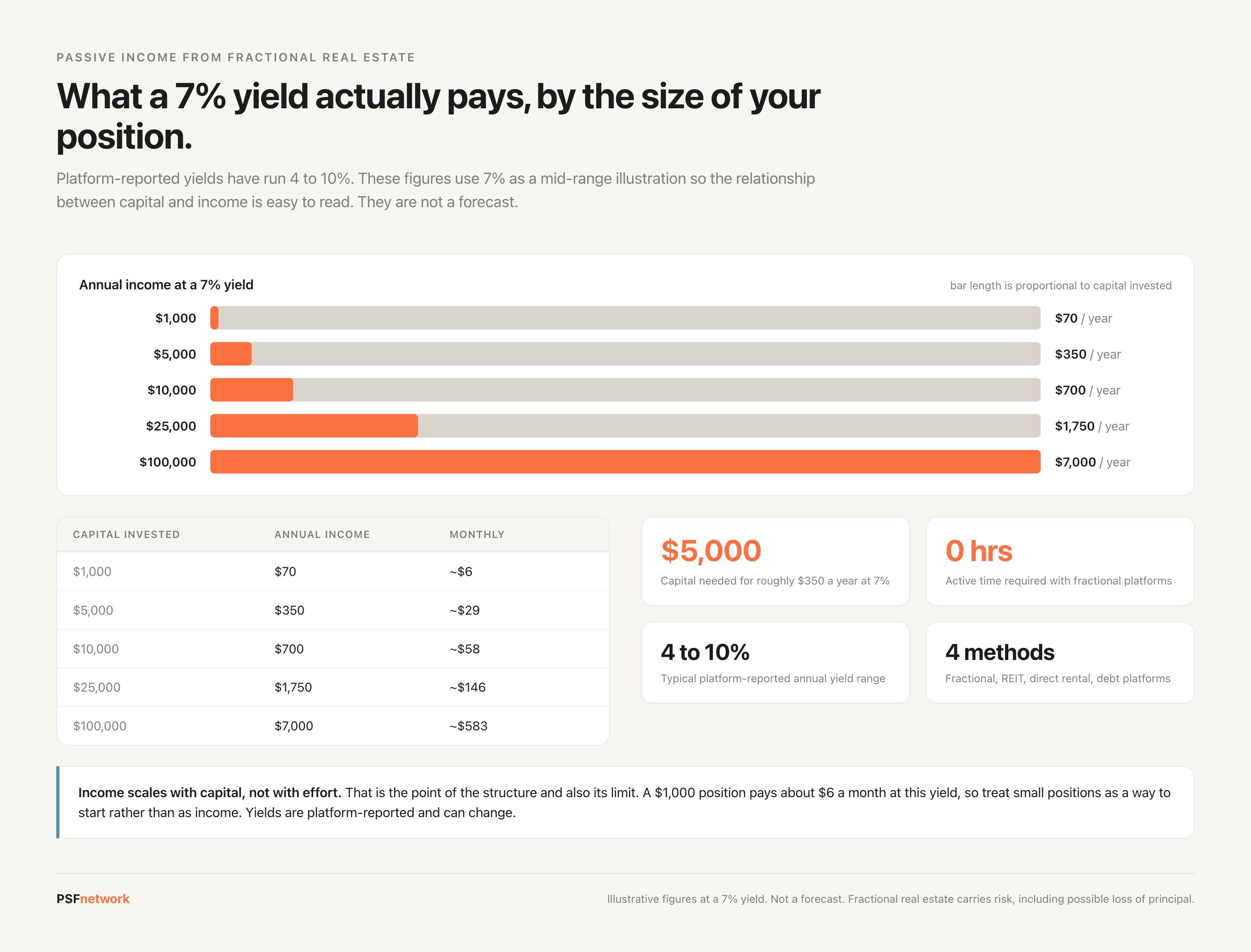
Platform-reported yields on fractional real estate typically fall in a 4 to 10 percent annual range, with additional return potential from appreciation. A $5,000 stake at the midpoint of that range generates roughly $350 a year. These figures are illustrative and not promised, and returns vary by platform, by vintage, and by individual property. Past performance does not predict future results.
The math is straightforward, but the assumptions matter. Annual yield is calculated on the current investment value, not on your original cost. If the property appreciates, the dollar income grows even when the percentage stays flat. If the property loses value, the opposite happens. Here is a simple illustration at the platform-reported midpoint of 7 percent.
Capital invested | Estimated annual income at 7% | Estimated monthly income |
|---|---|---|
$1,000 | $70 | ~$6 |
$5,000 | $350 | ~$29 |
$10,000 | $700 | ~$58 |
$25,000 | $1,750 | ~$146 |
$100,000 | $7,000 | ~$583 |
Each row assumes a flat 7 percent annual yield through the year on constant principal. Actual yields and principal values both vary, often materially. To generate $1,000 a month at the 7 percent midpoint, you would need roughly $171,000 invested. That is the scale of the goal, not a promise, and required capital scales with the yield assumption, so lower yields require proportionally more. For most investors, reaching that level means reinvesting distributions for several years before drawing any income.
What are the four ways to earn passive real estate income?
There are four primary methods: fractional real estate platforms, real estate investment trusts (REITs), direct rental property, and real estate debt, meaning mortgage notes or debt-focused platforms where you lend rather than own. Each has a different minimum, effort level, tax form, and risk profile. Most readers should start with fractional platforms or publicly traded REITs, because the minimums and the operational burden are both lowest there. Among rental properties for passive income, the fractional version is what removes the landlord work while keeping the rent.
Method | Typical minimum | Effort | Income tax form | Reported yield range |
|---|---|---|---|---|
Fractional platforms | $20 to $5,000 | None | K-1 (Form 1065) | 4 to 10% (platform-reported) |
Publicly traded REITs | Price of one share, or fractional on a broker | None | 1099-DIV (most) | Varies by REIT; daily price moves affect effective yield |
Direct rental property | 20% down on property cost | High, or pay a manager | Schedule E | 8 to 12% cash-on-cash (leveraged, varies) |
Real estate debt (notes, debt platforms) | $10 to $5,000 per platform | None | 1099-INT or K-1 | Varies, typically yield-focused |
Most publicly traded REITs send a 1099, though some non-traded REITs send a K-1, so check the offering documents. Cash-on-cash figures for direct rentals assume a 20 to 25 percent down payment and typical operating expenses, and they vary materially by market.
Fractional platforms sell shares of a single property through an LLC. Examples include Fundrise, Arrived, Ark7, and PSFnetwork, which sells ownership by the square foot. The LLC is the issuer and you are a member, not a direct property owner, so tax reporting is usually a K-1. This is the core of passive real estate investing for people who want the income without the title.
REITs pool many properties into one entity, and most distribute at least 90 percent, often closer to 100 percent, of their taxable income to shareholders as dividends. Publicly traded REITs trade like stocks. Non-traded REITs carry extra risks: they may pay distributions out of offering proceeds rather than property cash flow, and they often have external managers with potential conflicts of interest.
Direct rental property is the most active option. You hold title, and you handle maintenance and tenants yourself or pay a manager 8 to 10 percent of rent to do it. Rental income is reported on Schedule E (Form 1040), and returns vary widely by market, leverage, and vacancy. This is what people usually mean by owning rental properties for passive income, though the word passive only applies once you have paid someone else to run them.
Real estate debt means you are the lender rather than the equity holder. You put up money that funds a property loan, and you earn interest on it rather than a share of rent or appreciation. The upside is capped at the interest rate, but the income is more predictable, and the main risk shifts from vacancy to borrower default. For an investor who wants scheduled payments over growth, it is a distinct and useful tool.
How do you start with fractional real estate platforms?
There are five steps. Pick a platform with a clear SEC filing, fund an account, browse offerings and read at least one offering circular in full, place your first share purchase, and set distributions to auto-reinvest if you are early in your timeline. The first distribution typically arrives within one to three months and is paid in proportion to your share of the property. This is the most common answer to how to build passive income with real estate from a standing start.
Before you fund anything, verify the platform's SEC filings by searching EDGAR for the offering. Confirm it is filed under Regulation A, which is open to non-accredited investors, or Regulation D, which is accredited only. Under Regulation A Tier 2, a non-accredited investor may invest no more than 10 percent of the greater of their annual income or net worth in a single offering, so size your position with that cap in mind. Read the risk factors section of the offering circular in full, because that is the document that legally governs your investment.
After the first investment, the mechanics are uneventful by design. Rent comes in, the platform deducts expenses and fees, and a distribution lands in your account on a schedule, often monthly for fractional platforms and quarterly for some REITs. You can usually choose to reinvest or to take the cash.
What should you do with the distributions?
If you are within five years of your income goal, reinvest. If you are at or past it, draw the income. If you need cash sooner, draw immediately and accept the slower compounding. Reinvesting in the early years matters out of all proportion, because each new share earns its own distributions, which compounds. Stopping reinvestment too early flattens the long-run trajectory. Here is a simple illustration at a 7 percent annual yield reinvested.
Year | Reinvested principal (starting $5,000) |
|---|---|
0 | $5,000 |
3 | ~$6,125 |
5 | ~$7,015 |
10 | ~$9,836 |
15 | ~$13,795 |
The principal roughly doubles every 10 years at 7 percent compounded. That is the rule of 72 at work, applied to a real estate yield rather than a stock return: same math, different volatility. If your goal is monthly cash flow now, you skip reinvestment and take the distributions. Many platforms let you toggle this in account settings, though some do not offer it by default and require a request to support.
What are the risks of real estate passive income?
There are four risk categories: liquidity, vacancy, platform, and concentration. None of them can be eliminated, but each can be reduced by diversifying across properties, platforms, and methods.
Liquidity is the first. Fractional shares and non-traded REITs are not as liquid as public stocks. Some platforms run a secondary market and many do not, so plan to hold for five years or more. PSFnetwork has no current secondary market, which means shares may be difficult or impossible to sell before the property is sold, so be prepared to hold for the full term. Vacancy is the second. A property without tenants does not produce distributions for that period, and reserves plus diversification across properties soften the blow, while a single-property stake is the most exposed. Platform risk is the third. The operator itself can fail or change terms, and although the underlying property sits in an LLC separate from the platform, recovering full value in a failed-platform scenario can take months or years and is not guaranteed. Concentration is the fourth. One property in one market is a single decision, and spreading across multiple properties, platforms, and ideally multiple methods, including fractional, REIT, and real estate debt where you lend for interest, reduces the damage any one of them can do.
Real estate passive income is not FDIC insured and it is not a savings account. Treat it as an investment with a return profile somewhere between stocks and bonds, carrying its own particular risks.
The honest version of passive income real estate is less glamorous than the slogan and more useful. The income is real, it recurs, and the most hands-off routes, fractional shares, REITs, and real estate debt where you lend for interest, genuinely do remove the landlord work. What they do not remove is the risk, the multi-year hold, or the need to choose well, because the effort in this asset class lives in the selection, not the day-to-day. If you are starting out, the most practical real estate passive income ideas are also the simplest: begin small on a regulated fractional platform or a publicly traded REIT, verify every SEC filing before you fund anything, reinvest the early distributions instead of spending them, and spread your money across more than one property and method so a single vacancy or a single failed operator cannot undo you. Build the principal patiently, and the income follows. Treat it as a return profile that sits between stocks and bonds, not as a guaranteed check, and it can be a durable, cash-flowing part of a portfolio rather than the get-rich story the word "passive" tends to promise.
Sources:
Internal Revenue Service, "About Schedule E (Form 1040)", https://www.irs.gov/forms-pubs/about-schedule-e-form-1040
Internal Revenue Service, "About Form 8582, Passive Activity Loss Limitations", https://www.irs.gov/forms-pubs/about-form-8582
Internal Revenue Service, "About Schedule K-1 (Form 1065)", https://www.irs.gov/instructions/i1065sk1
SEC Office of Investor Education (investor.gov), "Real Estate Investment Trusts (REITs)", https://www.investor.gov/introduction-investing/investing-basics/investment-products/real-estate-investment-trusts-reits
Federal Deposit Insurance Corporation, "Deposit Insurance", https://www.fdic.gov/resources/deposit-insurance/
Concreit, "Rental Property vs. Fractional Real Estate Investing", https://www.concreit.com/blog/rental-property-vs-fractional-real-estate-investing
See the per-square-foot math on a real property ›
PSFnetwork's offerings are made only under qualified offering documents. Review the offering circular and risk factors before you invest. All investments involve risk, including the possible loss of principal.
Disclaimer: This article is for educational purposes only and does not constitute financial, investment, legal, or tax advice. PSFnetwork investments involve risk, including potential loss of principal. Past performance does not guarantee future returns. Investments are offered through PSF Capital LLC under Reg A+ exemptions. Please review the offering circular and consult a qualified financial advisor before making investment decisions.
Most people picture passive income real estate as a paid-off rental that mails them a check every month. The reality is closer to the opposite: a house with tenants is a small business with a 2 a.m. phone problem. The income can be real and recurring, but the genuinely hands-off versions of it look nothing like being a landlord, and that distinction is the whole point of this guide.
Quick Answer (60 seconds)
Passive income real estate works through two channels. Rental distributions are the monthly or quarterly cash a property's tenants generate, and appreciation is the price increase you realize when a property is sold. Fractional platforms let you access both without owning a whole property or managing tenants, which is why they have become the default route for hands-off investors. As an illustration, $5,000 invested at a 7 percent annual yield generates roughly $350 a year, growing if you reinvest. Returns vary by platform, vintage, and property, so these figures are illustrative, not promised. All real estate investing carries risk, including the possible loss of principal.
Quick numbers:
4 to 10%: a typical platform-reported annual yield range
$5,000: the capital to generate about $350 a year at 7 percent (illustrative)
4 methods: fractional, REIT, direct rental, and real estate debt
Minimal active time: the work required with fractional ownership, once you have chosen
Past performance does not predict future results. All investments carry risk including loss of principal.
"Passive" is one of the most oversold words in finance. A house with tenants is a business. A REIT in your brokerage account is a stock that can fall 30 percent in a year. Real estate can produce real, recurring income, but the work is in the choosing, not the running. This guide walks through the four real ways to earn passive income from real estate, the math behind each, and how to start. For most readers the lead path is fractional platforms, because they remove the operational burden without removing the income. Direct ownership is here for the readers who want maximum control and can absorb the time and the concentration risk that come with it.
What is passive income from real estate?
Passive income from real estate is recurring income from property without active management on your part. It comes from two sources. Rental distributions are paid out from what the property's tenants pay, and appreciation is realized when the property is sold. How passive it really is depends on the structure. Fractional shares and REITs are largely hands-off because a platform or fund runs the property. Real estate debt, where you act as the lender and earn interest rather than owning the building, is also hands-off once your money is committed. Owning and renting a property yourself is the opposite: it takes real work, or it takes paying someone to do that work for you.
Passive income from real estate is not the same as a savings account or a bond coupon. The cash flow can be volatile, the principal can fall, and the timing of distributions depends on whether a property is occupied. What it offers that bonds do not is exposure to property appreciation and a different correlation profile from public markets.
The tax treatment also differs. Under the Internal Revenue Code, rental real estate is generally treated as a passive activity, governed by Form 8582 for loss limitations. This matters because passive losses can usually only offset passive income, not your salary. Consult a tax advisor on your specific situation.
How much passive income can real estate generate?
Platform-reported yields on fractional real estate typically fall in a 4 to 10 percent annual range, with additional return potential from appreciation. A $5,000 stake at the midpoint of that range generates roughly $350 a year. These figures are illustrative and not promised, and returns vary by platform, by vintage, and by individual property. Past performance does not predict future results.
The math is straightforward, but the assumptions matter. Annual yield is calculated on the current investment value, not on your original cost. If the property appreciates, the dollar income grows even when the percentage stays flat. If the property loses value, the opposite happens. Here is a simple illustration at the platform-reported midpoint of 7 percent.
Capital invested | Estimated annual income at 7% | Estimated monthly income |
|---|---|---|
$1,000 | $70 | ~$6 |
$5,000 | $350 | ~$29 |
$10,000 | $700 | ~$58 |
$25,000 | $1,750 | ~$146 |
$100,000 | $7,000 | ~$583 |
Each row assumes a flat 7 percent annual yield through the year on constant principal. Actual yields and principal values both vary, often materially. To generate $1,000 a month at the 7 percent midpoint, you would need roughly $171,000 invested. That is the scale of the goal, not a promise, and required capital scales with the yield assumption, so lower yields require proportionally more. For most investors, reaching that level means reinvesting distributions for several years before drawing any income.
What are the four ways to earn passive real estate income?
There are four primary methods: fractional real estate platforms, real estate investment trusts (REITs), direct rental property, and real estate debt, meaning mortgage notes or debt-focused platforms where you lend rather than own. Each has a different minimum, effort level, tax form, and risk profile. Most readers should start with fractional platforms or publicly traded REITs, because the minimums and the operational burden are both lowest there. Among rental properties for passive income, the fractional version is what removes the landlord work while keeping the rent.
Method | Typical minimum | Effort | Income tax form | Reported yield range |
|---|---|---|---|---|
Fractional platforms | $20 to $5,000 | None | K-1 (Form 1065) | 4 to 10% (platform-reported) |
Publicly traded REITs | Price of one share, or fractional on a broker | None | 1099-DIV (most) | Varies by REIT; daily price moves affect effective yield |
Direct rental property | 20% down on property cost | High, or pay a manager | Schedule E | 8 to 12% cash-on-cash (leveraged, varies) |
Real estate debt (notes, debt platforms) | $10 to $5,000 per platform | None | 1099-INT or K-1 | Varies, typically yield-focused |
Most publicly traded REITs send a 1099, though some non-traded REITs send a K-1, so check the offering documents. Cash-on-cash figures for direct rentals assume a 20 to 25 percent down payment and typical operating expenses, and they vary materially by market.
Fractional platforms sell shares of a single property through an LLC. Examples include Fundrise, Arrived, Ark7, and PSFnetwork, which sells ownership by the square foot. The LLC is the issuer and you are a member, not a direct property owner, so tax reporting is usually a K-1. This is the core of passive real estate investing for people who want the income without the title.
REITs pool many properties into one entity, and most distribute at least 90 percent, often closer to 100 percent, of their taxable income to shareholders as dividends. Publicly traded REITs trade like stocks. Non-traded REITs carry extra risks: they may pay distributions out of offering proceeds rather than property cash flow, and they often have external managers with potential conflicts of interest.
Direct rental property is the most active option. You hold title, and you handle maintenance and tenants yourself or pay a manager 8 to 10 percent of rent to do it. Rental income is reported on Schedule E (Form 1040), and returns vary widely by market, leverage, and vacancy. This is what people usually mean by owning rental properties for passive income, though the word passive only applies once you have paid someone else to run them.
Real estate debt means you are the lender rather than the equity holder. You put up money that funds a property loan, and you earn interest on it rather than a share of rent or appreciation. The upside is capped at the interest rate, but the income is more predictable, and the main risk shifts from vacancy to borrower default. For an investor who wants scheduled payments over growth, it is a distinct and useful tool.
How do you start with fractional real estate platforms?
There are five steps. Pick a platform with a clear SEC filing, fund an account, browse offerings and read at least one offering circular in full, place your first share purchase, and set distributions to auto-reinvest if you are early in your timeline. The first distribution typically arrives within one to three months and is paid in proportion to your share of the property. This is the most common answer to how to build passive income with real estate from a standing start.
Before you fund anything, verify the platform's SEC filings by searching EDGAR for the offering. Confirm it is filed under Regulation A, which is open to non-accredited investors, or Regulation D, which is accredited only. Under Regulation A Tier 2, a non-accredited investor may invest no more than 10 percent of the greater of their annual income or net worth in a single offering, so size your position with that cap in mind. Read the risk factors section of the offering circular in full, because that is the document that legally governs your investment.
After the first investment, the mechanics are uneventful by design. Rent comes in, the platform deducts expenses and fees, and a distribution lands in your account on a schedule, often monthly for fractional platforms and quarterly for some REITs. You can usually choose to reinvest or to take the cash.
What should you do with the distributions?
If you are within five years of your income goal, reinvest. If you are at or past it, draw the income. If you need cash sooner, draw immediately and accept the slower compounding. Reinvesting in the early years matters out of all proportion, because each new share earns its own distributions, which compounds. Stopping reinvestment too early flattens the long-run trajectory. Here is a simple illustration at a 7 percent annual yield reinvested.
Year | Reinvested principal (starting $5,000) |
|---|---|
0 | $5,000 |
3 | ~$6,125 |
5 | ~$7,015 |
10 | ~$9,836 |
15 | ~$13,795 |
The principal roughly doubles every 10 years at 7 percent compounded. That is the rule of 72 at work, applied to a real estate yield rather than a stock return: same math, different volatility. If your goal is monthly cash flow now, you skip reinvestment and take the distributions. Many platforms let you toggle this in account settings, though some do not offer it by default and require a request to support.
What are the risks of real estate passive income?
There are four risk categories: liquidity, vacancy, platform, and concentration. None of them can be eliminated, but each can be reduced by diversifying across properties, platforms, and methods.
Liquidity is the first. Fractional shares and non-traded REITs are not as liquid as public stocks. Some platforms run a secondary market and many do not, so plan to hold for five years or more. PSFnetwork has no current secondary market, which means shares may be difficult or impossible to sell before the property is sold, so be prepared to hold for the full term. Vacancy is the second. A property without tenants does not produce distributions for that period, and reserves plus diversification across properties soften the blow, while a single-property stake is the most exposed. Platform risk is the third. The operator itself can fail or change terms, and although the underlying property sits in an LLC separate from the platform, recovering full value in a failed-platform scenario can take months or years and is not guaranteed. Concentration is the fourth. One property in one market is a single decision, and spreading across multiple properties, platforms, and ideally multiple methods, including fractional, REIT, and real estate debt where you lend for interest, reduces the damage any one of them can do.
Real estate passive income is not FDIC insured and it is not a savings account. Treat it as an investment with a return profile somewhere between stocks and bonds, carrying its own particular risks.
The honest version of passive income real estate is less glamorous than the slogan and more useful. The income is real, it recurs, and the most hands-off routes, fractional shares, REITs, and real estate debt where you lend for interest, genuinely do remove the landlord work. What they do not remove is the risk, the multi-year hold, or the need to choose well, because the effort in this asset class lives in the selection, not the day-to-day. If you are starting out, the most practical real estate passive income ideas are also the simplest: begin small on a regulated fractional platform or a publicly traded REIT, verify every SEC filing before you fund anything, reinvest the early distributions instead of spending them, and spread your money across more than one property and method so a single vacancy or a single failed operator cannot undo you. Build the principal patiently, and the income follows. Treat it as a return profile that sits between stocks and bonds, not as a guaranteed check, and it can be a durable, cash-flowing part of a portfolio rather than the get-rich story the word "passive" tends to promise.
Sources:
Internal Revenue Service, "About Schedule E (Form 1040)", https://www.irs.gov/forms-pubs/about-schedule-e-form-1040
Internal Revenue Service, "About Form 8582, Passive Activity Loss Limitations", https://www.irs.gov/forms-pubs/about-form-8582
Internal Revenue Service, "About Schedule K-1 (Form 1065)", https://www.irs.gov/instructions/i1065sk1
SEC Office of Investor Education (investor.gov), "Real Estate Investment Trusts (REITs)", https://www.investor.gov/introduction-investing/investing-basics/investment-products/real-estate-investment-trusts-reits
Federal Deposit Insurance Corporation, "Deposit Insurance", https://www.fdic.gov/resources/deposit-insurance/
Concreit, "Rental Property vs. Fractional Real Estate Investing", https://www.concreit.com/blog/rental-property-vs-fractional-real-estate-investing
See the per-square-foot math on a real property ›
PSFnetwork's offerings are made only under qualified offering documents. Review the offering circular and risk factors before you invest. All investments involve risk, including the possible loss of principal.
Disclaimer: This article is for educational purposes only and does not constitute financial, investment, legal, or tax advice. PSFnetwork investments involve risk, including potential loss of principal. Past performance does not guarantee future returns. Investments are offered through PSF Capital LLC under Reg A+ exemptions. Please review the offering circular and consult a qualified financial advisor before making investment decisions.
Sources
1. Internal Revenue Service (IRS), "About Schedule E (Form 1040)"
2. IRS, "About Form 8582, Passive Activity Loss Limitations", referenced via Schedule E page
3. IRS, "Partner's Instructions for Schedule K-1 (Form 1065)"
4. SEC Office of Investor Education (investor.gov), "Real Estate Investment Trusts (REITs)"
5. Federal Deposit Insurance Corporation, "What Is Deposit Insurance?"
6. Concreit, "Rental Property vs. Fractional Real Estate Investing"
Youssef Kholeif
CMO, PSFnetwork
Disclaimer
This article is for educational purposes only and does not constitute financial, investment, legal, or tax advice. Investments involve risk, including potential loss of principal. Past performance does not guarantee future returns. Investments are offered through PSFnetwork MasterSeries LLC under Reg A. Please review the offering circular and consult a qualified financial advisor before making investment decisions.

Ready When You are
Start from square one
Browse fractional properties across US metros. No accreditation required.
Ready When You are
Start from square one
Browse fractional properties across US metros. No accreditation required.
Keep Reading





Important information
© 2026 PSFnetwork. All rights reserved.
Important information
© 2026 PSFnetwork. All rights reserved.