Getting Started
Getting Started
How to Invest in Real Estate With $100 (or Less) in 2026
How to Invest in Real Estate With $100 (or Less) in 2026
How to Invest in Real Estate With $100 (or Less) in 2026
You do not need a down payment. You do not need to be wealthy. Here is the honest guide to starting a real estate portfolio with $100, and the math behind what it does for you.
You do not need a down payment. You do not need to be wealthy. Here is the honest guide to starting a real estate portfolio with $100, and the math behind what it does for you.
You do not need a down payment. You do not need to be wealthy. Here is the honest guide to starting a real estate portfolio with $100, and the math behind what it does for you.

Youssef Kholeif
CMO, PSFnetwork
CMO, PSFnetwork
Published
Published
Published
•
•

TL;DR
In 2026, you can invest in real estate with as little as $10 to $100 through fractional platforms and real estate funds that hold rental properties or commercial buildings. Examples include Fundrise (from $10), Ark7 (from $20), Lofty (from $50), Realbricks (from $100), Arrived (from $100), and psfnetwork. Distributions are paid from rental income, typically monthly or quarterly. Starting small is genuinely useful: the compounding mechanism begins immediately, even if absolute dollar amounts are modest. All such investments involve risk, including loss of principal.
In 2026, you can invest in real estate with as little as $10 to $100 through fractional platforms and real estate funds that hold rental properties or commercial buildings. Examples include Fundrise (from $10), Ark7 (from $20), Lofty (from $50), Realbricks (from $100), Arrived (from $100), and psfnetwork. Distributions are paid from rental income, typically monthly or quarterly. Starting small is genuinely useful: the compounding mechanism begins immediately, even if absolute dollar amounts are modest. All such investments involve risk, including loss of principal.
Owning a slice of property no longer requires a six-figure down payment. Here is how small-dollar real estate investing works in 2026, and what to watch before you commit.
A traditional rental purchase often starts with a deposit of tens of thousands of dollars. That single number has kept most people out of property for generations. In 2026, the math looks different. Several platforms now let you buy a stake in real estate for the price of a nice dinner, and the question of how to invest in real estate with $100 has a real, practical answer rather than a marketing slogan. The catch is that "small" does not mean "simple," so it pays to understand exactly what your hundred dollars buys.
Quick Answer (60 seconds)
You can start investing in real estate with $100 or less through fractional platforms, real estate crowdfunding, and some publicly traded real estate investment trusts, or REITs. Each one lets you own a small piece of property without a mortgage or a landlord's workload.
The mechanics are straightforward. You pick a platform, fund your account, choose where your money goes, and the platform handles the operations. Your $100 buys a proportional claim on the underlying property or portfolio, and any income flows back to you as distributions.
Fractional platforms like PSFnetwork take this a step further. Ownership is measured per square foot and tied to a specific property, so you can see exactly what backs your money. PSFnetwork offerings are structured under Regulation A, an SEC framework open to both accredited and non-accredited investors.
Stat cards:
Regulation A, Tier 1 lets a company raise up to $20 million per rolling 12 months, per the SEC.
Regulation A, Tier 2 lets a company raise up to $75 million per rolling 12 months, per the SEC.
Regulation A offerings are open to both accredited and non-accredited investors, per the SEC.
Regulation Crowdfunding allows a company to raise up to $5 million per 12 months, per the SEC.
An accredited investor generally needs income above $200,000 or net worth above $1 million, excluding a primary residence, per the SEC.
Risk note: All real estate investments carry risk including loss of principal.
Why $100 Changes the Conversation
For most of modern history, real estate was a club with a steep cover charge. A direct purchase meant a large down payment, a mortgage approval, closing costs, and the responsibility of one address resting on your balance sheet. If you did not have the capital, you simply watched from the sidelines.
A $100 entry point rewrites that. It moves real estate from an "after I save for years" goal to a "this month" decision. That shift matters for two reasons.
First, it makes diversification realistic. Instead of pouring every spare dollar into one property, you can spread small amounts across more than one asset. Diversification, meaning not betting everything on a single outcome, is far easier when the minimum is low.
Second, a small minimum lowers the cost of learning. You can see how an offering works, how income is reported, and how a platform communicates, all without risking money you cannot afford to lose. That hands-on familiarity tends to build more confidence than any brochure.
None of this removes risk. A small stake is still a real investment, and the value can fall. The point is access, not a shortcut around the basics.
Traditional Real Estate vs. Low-Minimum Alternatives
The cleanest way to see the difference is side by side. Traditional ownership gives you full control and full responsibility. Low-minimum routes hand the operational work to someone else in exchange for a smaller, shared stake.
Dimension | Traditional Property Purchase | Low-Minimum Alternatives |
Typical entry cost | Large down payment, often tens of thousands | As low as $100, depending on the platform |
Mortgage | Usually required | Not required by the investor |
Management | You handle tenants and repairs | Platform or sponsor handles operations |
Diversification | Hard; capital sits in one property | Easier; spread small amounts across assets |
Control | Full control over the asset | Limited; you own a defined slice |
Liquidity | Sell the whole property, can take months | Varies by offering; often limited |
Within the low-minimum category, you have a few common paths. Publicly traded REITs let you buy shares that trade like stocks, with your money pooled across many buildings. Real estate crowdfunding pools capital online to fund specific projects, often under Regulation Crowdfunding, which allows raises up to $5 million per 12 months and is open to non-accredited investors. Fractional ownership ties your stake to a single, identifiable property rather than a broad pool.
Each route trades control for access. The right fit depends on whether you want broad diversification, a specific project, or a defined slice of one named building.
How PSFnetwork Lets You Start With $100
PSFnetwork is a fractional real estate investing platform where ownership is measured per square foot and tied to a specific property. Instead of buying shares in a fund that holds dozens of buildings, you buy a defined number of square feet in one building you can point to.
Three features keep small-dollar investing workable.
First, the properties are mortgage-free. There is no loan sitting on the asset, which removes the interest payments and financing risk that come with a traditional purchase. Your distributions are not competing with a bank's monthly cut.
Second, the properties are income-oriented. They are selected with the goal of producing rental income, and that income is distributed to investors according to how many square feet they hold.
Third, PSFnetwork handles the operations. Tenant management, maintenance, and the administrative tracking of who owns what all sit with the platform, not with you.
PSFnetwork offerings are structured under Regulation A, the SEC framework that lets both accredited and non-accredited investors participate. Because offerings are qualified under this framework, you can review the offering circular, a detailed SEC-filed disclosure document, rather than relying on marketing alone. One clarification worth making: PSFnetwork is an investing platform, not a forum or a community-dialogue space. The focus stays on the properties and the investment.
Step-by-Step: How to Make Your First Investment
Starting small is more straightforward than buying a rental outright. Here is the general path.
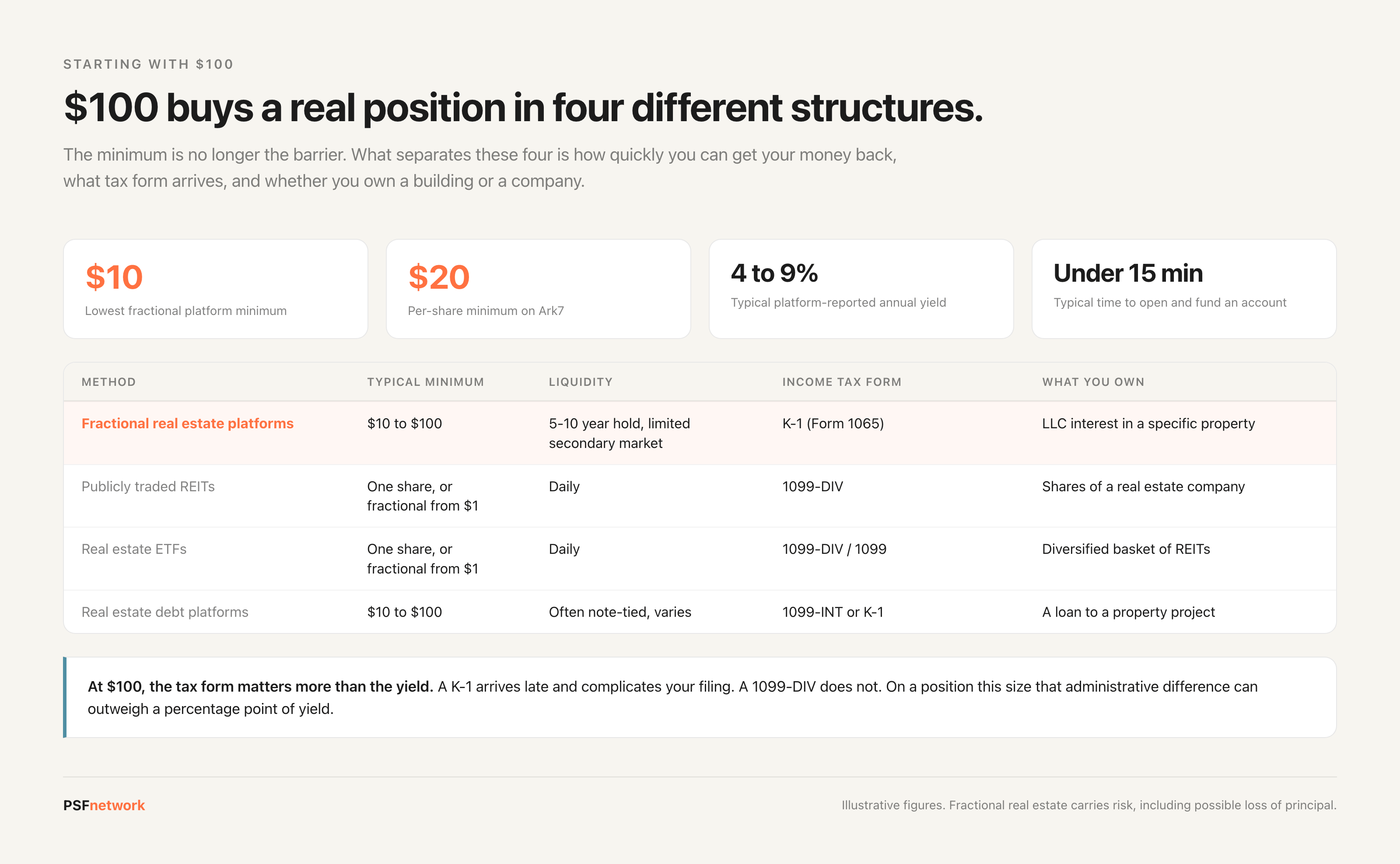
Step 1: Set a simple goal
Decide what you want from the investment. Many newer investors use fractional real estate for diversification, spreading modest amounts across assets rather than concentrating them. Knowing your goal helps you size your first commitment.
Step 2: Check your investor status
Some private offerings are limited to accredited investors. An accredited investor generally needs income above $200,000, or $300,000 jointly with a spouse, or a net worth above $1 million excluding a primary residence, per the SEC. The good news for beginners: Regulation A offerings, including PSFnetwork, are open to non-accredited investors too.
Step 3: Choose a property
On a fractional platform, you review the available properties and pick one that fits your goal. With PSFnetwork, you also decide how many square feet you want to own in that specific building, which sets the amount you invest.
Step 4: Read the offering documents
Before you commit a dollar, read the offering circular. Because Regulation A offerings file with the SEC, you can review these disclosures through the EDGAR database on SEC.gov. This is where you confirm the risks, fees, and structure in plain writing.
Step 5: Fund and invest
Once you complete the transaction online, typically on a mobile-friendly dashboard, the platform handles ownership tracking and distributes any income to your account. From there, your main job is monitoring performance, not fixing faucets.
What to Expect: Returns, Risk, and Liquidity
Small does not mean risk-free, and a careful investor reads the fine print before committing.
Start with returns. Any yield or performance figure you see on a platform is platform-reported and may vary. Returns are not guaranteed, and historical performance does not predict future results. Treat past numbers as context, not a promise. Income, where it exists, generally comes from the property's operations and depends on the asset.
Next, risk. All real estate investments carry risk including loss of principal. Property values can fall, tenants can leave, and distributions can pause. No platform can honestly promise a guaranteed or risk-free return, and any claim framed that way deserves skepticism.
Then liquidity, meaning how quickly you can turn your stake back into cash. Real estate is not a stock you can sell in a second. Fractional investments can be harder to exit than publicly traded REITs, and secondary markets may be limited. Plan to hold for the medium to long term, and only invest money you will not need soon.
Finally, fees. Transparent fee structures are a sign of a trustworthy platform. Read how the platform charges, what comes out of your distributions, and whether any costs are bundled in ways that are hard to see.
A $100 starting point does not turn real estate into a sure thing, but it does turn it into an option. The barriers that once required a mortgage, a large deposit, and a tolerance for midnight repair calls have come down. In their place sits a simpler choice: pick a route that matches your goal, commit an amount you can afford, and let professionals handle the building.
The routes are clear. Publicly traded REITs offer broad diversification. Crowdfunding lets you back specific projects. Fractional ownership ties your money to a single property you choose. Each one hands the day-to-day work to someone else so you can focus on your own goals.
The discipline that matters most is doing your homework. Read the offering documents, understand the fees, check the liquidity terms, and confirm who can invest. None of these options is risk-free, and honest platforms never pretend otherwise. Start small, learn how the structure behaves, and scale only when you understand what you own.
PSFnetwork offers fractional real estate measured per square foot and tied to a specific property. Offerings are structured under Regulation A, feature mortgage-free, income-oriented assets, and are open to both accredited and non-accredited investors. Review the offering documents before investing.
Sources
U.S. Securities and Exchange Commission, Regulation A: https://www.sec.gov/smallbusiness/exemptofferings/rega
U.S. Securities and Exchange Commission, Regulation Crowdfunding: https://www.sec.gov/smallbusiness/exemptofferings/regcrowdfunding
U.S. Securities and Exchange Commission, Regulation D Rule 506(c): https://www.sec.gov/smallbusiness/exemptofferings/rule506c
U.S. Securities and Exchange Commission, Accredited Investor definition: https://www.sec.gov/resources-small-businesses/capital-raising-building-blocks/accredited-investor
Investor.gov, Real Estate Investment Trusts (REITs): https://www.investor.gov/introduction-investing/investing-basics/investment-products/real-estate-investment-trusts-reits
Disclaimer: This article is for educational purposes only and does not constitute financial, investment, legal, or tax advice. PSFnetwork investments involve risk, including potential loss of principal. Past performance does not guarantee future returns. Investments are offered through PSF Capital LLC under Reg A+ exemptions. Please review the offering circular and consult a qualified financial advisor before making investment decisions.
Owning a slice of property no longer requires a six-figure down payment. Here is how small-dollar real estate investing works in 2026, and what to watch before you commit.
A traditional rental purchase often starts with a deposit of tens of thousands of dollars. That single number has kept most people out of property for generations. In 2026, the math looks different. Several platforms now let you buy a stake in real estate for the price of a nice dinner, and the question of how to invest in real estate with $100 has a real, practical answer rather than a marketing slogan. The catch is that "small" does not mean "simple," so it pays to understand exactly what your hundred dollars buys.
Quick Answer (60 seconds)
You can start investing in real estate with $100 or less through fractional platforms, real estate crowdfunding, and some publicly traded real estate investment trusts, or REITs. Each one lets you own a small piece of property without a mortgage or a landlord's workload.
The mechanics are straightforward. You pick a platform, fund your account, choose where your money goes, and the platform handles the operations. Your $100 buys a proportional claim on the underlying property or portfolio, and any income flows back to you as distributions.
Fractional platforms like PSFnetwork take this a step further. Ownership is measured per square foot and tied to a specific property, so you can see exactly what backs your money. PSFnetwork offerings are structured under Regulation A, an SEC framework open to both accredited and non-accredited investors.
Stat cards:
Regulation A, Tier 1 lets a company raise up to $20 million per rolling 12 months, per the SEC.
Regulation A, Tier 2 lets a company raise up to $75 million per rolling 12 months, per the SEC.
Regulation A offerings are open to both accredited and non-accredited investors, per the SEC.
Regulation Crowdfunding allows a company to raise up to $5 million per 12 months, per the SEC.
An accredited investor generally needs income above $200,000 or net worth above $1 million, excluding a primary residence, per the SEC.
Risk note: All real estate investments carry risk including loss of principal.
Why $100 Changes the Conversation
For most of modern history, real estate was a club with a steep cover charge. A direct purchase meant a large down payment, a mortgage approval, closing costs, and the responsibility of one address resting on your balance sheet. If you did not have the capital, you simply watched from the sidelines.
A $100 entry point rewrites that. It moves real estate from an "after I save for years" goal to a "this month" decision. That shift matters for two reasons.
First, it makes diversification realistic. Instead of pouring every spare dollar into one property, you can spread small amounts across more than one asset. Diversification, meaning not betting everything on a single outcome, is far easier when the minimum is low.
Second, a small minimum lowers the cost of learning. You can see how an offering works, how income is reported, and how a platform communicates, all without risking money you cannot afford to lose. That hands-on familiarity tends to build more confidence than any brochure.
None of this removes risk. A small stake is still a real investment, and the value can fall. The point is access, not a shortcut around the basics.
Traditional Real Estate vs. Low-Minimum Alternatives
The cleanest way to see the difference is side by side. Traditional ownership gives you full control and full responsibility. Low-minimum routes hand the operational work to someone else in exchange for a smaller, shared stake.
Dimension | Traditional Property Purchase | Low-Minimum Alternatives |
Typical entry cost | Large down payment, often tens of thousands | As low as $100, depending on the platform |
Mortgage | Usually required | Not required by the investor |
Management | You handle tenants and repairs | Platform or sponsor handles operations |
Diversification | Hard; capital sits in one property | Easier; spread small amounts across assets |
Control | Full control over the asset | Limited; you own a defined slice |
Liquidity | Sell the whole property, can take months | Varies by offering; often limited |
Within the low-minimum category, you have a few common paths. Publicly traded REITs let you buy shares that trade like stocks, with your money pooled across many buildings. Real estate crowdfunding pools capital online to fund specific projects, often under Regulation Crowdfunding, which allows raises up to $5 million per 12 months and is open to non-accredited investors. Fractional ownership ties your stake to a single, identifiable property rather than a broad pool.
Each route trades control for access. The right fit depends on whether you want broad diversification, a specific project, or a defined slice of one named building.
How PSFnetwork Lets You Start With $100
PSFnetwork is a fractional real estate investing platform where ownership is measured per square foot and tied to a specific property. Instead of buying shares in a fund that holds dozens of buildings, you buy a defined number of square feet in one building you can point to.
Three features keep small-dollar investing workable.
First, the properties are mortgage-free. There is no loan sitting on the asset, which removes the interest payments and financing risk that come with a traditional purchase. Your distributions are not competing with a bank's monthly cut.
Second, the properties are income-oriented. They are selected with the goal of producing rental income, and that income is distributed to investors according to how many square feet they hold.
Third, PSFnetwork handles the operations. Tenant management, maintenance, and the administrative tracking of who owns what all sit with the platform, not with you.
PSFnetwork offerings are structured under Regulation A, the SEC framework that lets both accredited and non-accredited investors participate. Because offerings are qualified under this framework, you can review the offering circular, a detailed SEC-filed disclosure document, rather than relying on marketing alone. One clarification worth making: PSFnetwork is an investing platform, not a forum or a community-dialogue space. The focus stays on the properties and the investment.
Step-by-Step: How to Make Your First Investment
Starting small is more straightforward than buying a rental outright. Here is the general path.
Step 1: Set a simple goal
Decide what you want from the investment. Many newer investors use fractional real estate for diversification, spreading modest amounts across assets rather than concentrating them. Knowing your goal helps you size your first commitment.
Step 2: Check your investor status
Some private offerings are limited to accredited investors. An accredited investor generally needs income above $200,000, or $300,000 jointly with a spouse, or a net worth above $1 million excluding a primary residence, per the SEC. The good news for beginners: Regulation A offerings, including PSFnetwork, are open to non-accredited investors too.
Step 3: Choose a property
On a fractional platform, you review the available properties and pick one that fits your goal. With PSFnetwork, you also decide how many square feet you want to own in that specific building, which sets the amount you invest.
Step 4: Read the offering documents
Before you commit a dollar, read the offering circular. Because Regulation A offerings file with the SEC, you can review these disclosures through the EDGAR database on SEC.gov. This is where you confirm the risks, fees, and structure in plain writing.
Step 5: Fund and invest
Once you complete the transaction online, typically on a mobile-friendly dashboard, the platform handles ownership tracking and distributes any income to your account. From there, your main job is monitoring performance, not fixing faucets.
What to Expect: Returns, Risk, and Liquidity
Small does not mean risk-free, and a careful investor reads the fine print before committing.
Start with returns. Any yield or performance figure you see on a platform is platform-reported and may vary. Returns are not guaranteed, and historical performance does not predict future results. Treat past numbers as context, not a promise. Income, where it exists, generally comes from the property's operations and depends on the asset.
Next, risk. All real estate investments carry risk including loss of principal. Property values can fall, tenants can leave, and distributions can pause. No platform can honestly promise a guaranteed or risk-free return, and any claim framed that way deserves skepticism.
Then liquidity, meaning how quickly you can turn your stake back into cash. Real estate is not a stock you can sell in a second. Fractional investments can be harder to exit than publicly traded REITs, and secondary markets may be limited. Plan to hold for the medium to long term, and only invest money you will not need soon.
Finally, fees. Transparent fee structures are a sign of a trustworthy platform. Read how the platform charges, what comes out of your distributions, and whether any costs are bundled in ways that are hard to see.
A $100 starting point does not turn real estate into a sure thing, but it does turn it into an option. The barriers that once required a mortgage, a large deposit, and a tolerance for midnight repair calls have come down. In their place sits a simpler choice: pick a route that matches your goal, commit an amount you can afford, and let professionals handle the building.
The routes are clear. Publicly traded REITs offer broad diversification. Crowdfunding lets you back specific projects. Fractional ownership ties your money to a single property you choose. Each one hands the day-to-day work to someone else so you can focus on your own goals.
The discipline that matters most is doing your homework. Read the offering documents, understand the fees, check the liquidity terms, and confirm who can invest. None of these options is risk-free, and honest platforms never pretend otherwise. Start small, learn how the structure behaves, and scale only when you understand what you own.
PSFnetwork offers fractional real estate measured per square foot and tied to a specific property. Offerings are structured under Regulation A, feature mortgage-free, income-oriented assets, and are open to both accredited and non-accredited investors. Review the offering documents before investing.
Sources
U.S. Securities and Exchange Commission, Regulation A: https://www.sec.gov/smallbusiness/exemptofferings/rega
U.S. Securities and Exchange Commission, Regulation Crowdfunding: https://www.sec.gov/smallbusiness/exemptofferings/regcrowdfunding
U.S. Securities and Exchange Commission, Regulation D Rule 506(c): https://www.sec.gov/smallbusiness/exemptofferings/rule506c
U.S. Securities and Exchange Commission, Accredited Investor definition: https://www.sec.gov/resources-small-businesses/capital-raising-building-blocks/accredited-investor
Investor.gov, Real Estate Investment Trusts (REITs): https://www.investor.gov/introduction-investing/investing-basics/investment-products/real-estate-investment-trusts-reits
Disclaimer: This article is for educational purposes only and does not constitute financial, investment, legal, or tax advice. PSFnetwork investments involve risk, including potential loss of principal. Past performance does not guarantee future returns. Investments are offered through PSF Capital LLC under Reg A+ exemptions. Please review the offering circular and consult a qualified financial advisor before making investment decisions.
Youssef Kholeif
CMO, PSFnetwork
Disclaimer
This article is for educational purposes only and does not constitute financial, investment, legal, or tax advice. Investments involve risk, including potential loss of principal. Past performance does not guarantee future returns. Investments are offered through PSFnetwork MasterSeries LLC under Reg A. Please review the offering circular and consult a qualified financial advisor before making investment decisions.

Ready When You are
Start from square one
Browse fractional properties across US metros. No accreditation required.
Ready When You are
Start from square one
Browse fractional properties across US metros. No accreditation required.
Keep Reading



Important information
© 2026 PSFnetwork. All rights reserved.
Important information
© 2026 PSFnetwork. All rights reserved.