Fundamentals
Fundamentals
What Is Proptech? A 2026 Guide for Real Estate Investors
What Is Proptech? A 2026 Guide for Real Estate Investors
What Is Proptech? A 2026 Guide for Real Estate Investors
Proptech is the technology layer reshaping how real estate is bought, sold, rented, and invested in. Here is what it means, what it includes, and why a $51 to $55 billion market matters for everyday investors.
Proptech is the technology layer reshaping how real estate is bought, sold, rented, and invested in. Here is what it means, what it includes, and why a $51 to $55 billion market matters for everyday investors.
Proptech is the technology layer reshaping how real estate is bought, sold, rented, and invested in. Here is what it means, what it includes, and why a $51 to $55 billion market matters for everyday investors.

Youssef Kholeif
CMO, PSFnetwork
CMO, PSFnetwork
Published
Published
Published
•
•
TL;DR
Proptech (short for property technology) is the category of software, platforms, and digital infrastructure transforming the real estate industry. It includes fractional investment platforms, AI valuation tools, digital mortgage lenders, rental management software, and blockchain property registries. Industry research firms estimate the global proptech market at $51 to $55 billion in 2026, projected to grow at 14 to 18 percent annually through the early 2030s. For individual investors, the most relevant proptech development is fractional ownership platforms, which dropped the entry point for real estate investing from $20,000+ down payments to $10 to $100 shares.
Proptech (short for property technology) is the category of software, platforms, and digital infrastructure transforming the real estate industry. It includes fractional investment platforms, AI valuation tools, digital mortgage lenders, rental management software, and blockchain property registries. Industry research firms estimate the global proptech market at $51 to $55 billion in 2026, projected to grow at 14 to 18 percent annually through the early 2030s. For individual investors, the most relevant proptech development is fractional ownership platforms, which dropped the entry point for real estate investing from $20,000+ down payments to $10 to $100 shares.
A decade ago, putting money into real estate meant a down payment, a mortgage in your name, and a lawyer at a closing table. Today a $10 stake in a rental property settles on your phone in the time it takes to order coffee. The software that collapsed that distance has a name, proptech, and knowing what it does is the fastest way to see which of those changes actually reaches your portfolio and which only reaches the people who manage buildings.
Quick Answer (60 seconds)
Proptech, short for property technology, is the category of software, platforms, and digital infrastructure transforming the real estate industry. It covers fractional investment platforms, AI valuation tools, digital mortgage lenders, rental management software, and blockchain property registries. Industry research firms estimate the global proptech market at $51 to $55 billion in 2026, projected to grow at 14 to 18 percent annually through the early 2030s. For individual investors, the most relevant proptech development is fractional ownership platforms, which dropped the entry point for real estate investing from a $20,000-plus down payment to $10 to $100 shares. That single shift is why a guide to proptech is now useful to ordinary savers, not just to developers.
Quick numbers:
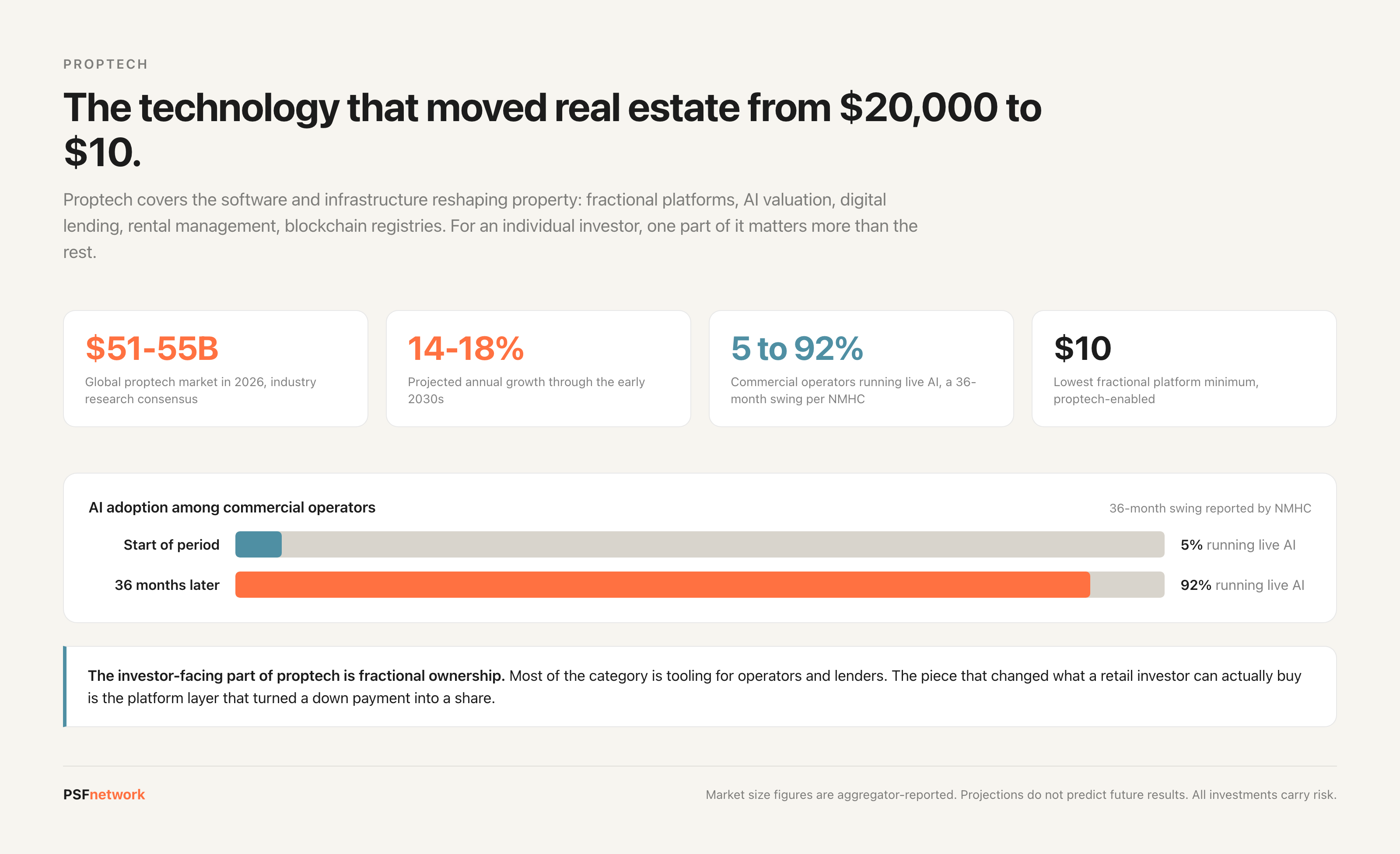
$51 to $55B: the global proptech market in 2026, by industry research consensus
14 to 18%: the projected annual growth rate through the early 2030s
5 to 92%: the swing in commercial operators running live AI over 36 months, per NMHC pulse data
$10: the lowest fractional platform minimum, proptech-enabled
Past performance and projections do not predict future results. Market size figures are aggregator-reported.
Proptech started life in tech-press headlines and now fills the annual reports of industry research firms. The category stretches from Zillow's listing search, the first wave, to today's blockchain title registries and AI-driven valuation tools. What unifies it is simple. It is software and digital infrastructure that automate, democratize, or replace pieces of the traditional real estate stack. For an investor, the useful question is not which proptech buzzword to chase but which proptech category actually changes how you can put capital into real estate. The honest answer is fractional ownership platforms. Almost everything else, from AI underwriting to smart leases to IoT building management, affects operators far more than it affects you.
What is proptech?
Proptech, short for property technology, is the category of software and digital platforms transforming real estate. The phrase is used interchangeably with real estate technology, and it spans listing portals, fractional investment platforms, AI valuation tools, digital mortgage lenders, rental management software, and blockchain title registries. The category emerged in the early 2010s alongside fintech and grew through three rough generations: the portal era (Zillow, Trulia), the crowdfunding era (Fundrise, RealtyMogul), and the current era of AI plus blockchain plus fractional ownership. Industry research firms now put the global market at $51 to $55 billion.
The history matters because proptech is so often used as a generic buzzword. Be specific instead. Proptech 1.0 digitized search and put listings online. Proptech 2.0 digitized access to ownership through crowdfunding and fractional platforms. Proptech 3.0 is automating decisions through AI valuation and underwriting, and rethinking title through tokenization and blockchain registries. For PSFnetwork's audience, the second wave is the one that opened real estate investing to capital sizes that could never reach it before, and the third wave is being built on top of that foundation.
What are the five categories of proptech?
The five categories most relevant to investors are investment platforms, AI valuation and underwriting, digital mortgage and lending, rental and property management software, and blockchain title and tokenization. Each has its own incumbents, its own regulatory frame, and a different level of relevance to you as an investor.
First, investment platforms. Fractional ownership platforms (Fundrise, Arrived, Ark7, Realbricks, PSFnetwork) and crowdfunding platforms (Groundfloor) are the most directly investor-relevant proptech. They let you put as little as $10 to $100 into a specific property or a fund-style position. Anyone scanning proptech companies for the ones that change personal access should start here.
Second, AI valuation and underwriting. Automated appraisal tools, the descendants of Zillow's Zestimate, and risk models that price deals. For fractional platforms, AI shapes which properties make it onto the platform, though you never touch the tool directly.
Third, digital mortgage and lending. Rocket Mortgage and similar players digitized loan origination, alongside closing technology, smart escrow, and electronic title. This affects buyers far more than fractional investors.
Fourth, rental and property management. Tenant screening, smart-home IoT for property managers, and automated maintenance dispatch. Industry surveys suggest AI adoption is now mainstream among multifamily managers, around 60 percent routine adoption per NMHC pulse data. This reaches fractional investors only indirectly, through operating efficiency.
Fifth, blockchain title and tokenization. On-chain title registries, still experimental in most US states, and tokenized fractional shares, where Lofty uses Algorand-based tokens. Regulatory ambiguity remains a meaningful barrier, and tokenized fractions are structurally different from Reg A LLC fractional platforms, so they carry additional considerations. Watching proptech trends in this category is worthwhile, but committing capital is another matter.
How is proptech relevant to individual investors?
For an individual investor, the single most important proptech development is fractional ownership platforms, which dropped real estate entry points from a $20,000-plus down payment to $10 to $100 shares. Everything else, the AI underwriting, the IoT building management, the smart leases, is operator-side technology that reaches you indirectly through cost structures. The investor-facing question is not which proptech is most cutting-edge but which fractional platform's structure matches your goal.
The honest framing is that proptech changed access, not returns. The returns still come from properties, tenants, and markets. What proptech changed is who could reach those returns and at what minimum. If you have $100 to $1,000 to start, fractional platforms are the proptech that matters. If you have $5,000 or more and care about diversification, REIT ETFs compete with fractional. If you have $50,000-plus and want active ownership, a traditional rental still wins on tax shelter and control, and proptech only makes the property faster to find and manage.
What AI applications exist in real estate today?
AI in real estate has moved from experimental pilots to mainstream operations. Industry surveys indicate the share of commercial operators running live AI models jumped from 5 percent to roughly 92 percent over the last 36 months, per NMHC pulse data cited by industry analysts. Practical applications include automated property valuation, tenant screening risk models, predictive maintenance, and underwriting automation for fractional platforms. Agentic AI, the autonomous decision-making frontier, is mostly still in pilots in 2026.
A few of these reach investors more than others. AI valuation feeds fractional platform property selection, so you never see the tool but the quality of the platform's pipeline depends on it. Underwriting automation filters property candidates faster, which means more options listed, but only if the model is well calibrated. Predictive maintenance flags repairs before they become emergencies, which can reduce repair costs and lift net operating income, and for a fractional investor that shows up as steadier distributions. Tenant screening models increasingly augment traditional credit checks, though consumer-protection rules around algorithmic tenant decisions remain a moving target. This is the kind of development that drives recurring proptech news without changing the basic investment case.
What proptech trends matter for 2026?
Three trends matter for investors this year. The first is agentic AI, autonomous models taking on operational tasks that go beyond pattern matching. The second is AI underwriting becoming standard at fractional platforms, which changes how quickly properties get listed. The third is platform consolidation, as 2026 vendors push integrated workflows rather than point solutions. The practical effect for investors is faster property listings and tighter operating margins, both of which can show up in yields over time.
Venture funding tells part of the story. Roughly $16.7 billion flowed into proptech globally in 2025, up about 68 percent year over year per industry sources, and that money shapes which categories grow and which consolidate. Fractional ownership and AI underwriting are among the most-funded sub-categories in 2026. Tokenization, by contrast, remains experimental for most US investors. Regulatory clarity on tokenized real estate securities is improving but unevenly, and for now Lofty's Algorand-based model is the most active US-accessible tokenized fractional product, with structural considerations that go beyond standard Reg A LLC platforms.
Strip away the jargon and proptech comes down to one plain idea: software that rewires how real estate gets bought, financed, managed, and owned. The category is large and getting larger, and most of it, the AI valuation engines, the smart-building sensors, the digital closings, matters to the people who operate property rather than to the people who invest small amounts in it. For an everyday investor, the part that changed the game is narrower and clearer. Fractional ownership platforms turned a five-figure down payment into a $10 to $100 share of a real building, and that is the proptech development worth understanding before any other. The rest is context. Watch the proptech trends if they interest you, read the proptech news for where the funding is going, but judge any individual opportunity the way you always should: by the property, the platform's track record, the fees, the regulatory filing, and the fit with your own timeline. Technology widened the door. What you walk through it to buy is still an investment, with all the risk that word carries.
Sources:
MRI Software, "PropTech Trends for 2026: What real estate leaders need to know", https://www.mrisoftware.com/blog/proptech-trends-for-2026-what-real-estate-leaders-need-to-know/
PwC / ULI, "Emerging Trends in Real Estate: proptech impact", https://www.pwc.com/us/en/industries/financial-services/asset-wealth-management/real-estate/emerging-trends-in-real-estate-pwc-uli/trends/proptech-impact.html
NAR Tech, "2026 Proptech Trends Real Estate Pros Can't Afford to Ignore", https://tech.realtor/2026/01/14/2026-proptech-trends-real-estate-pros-cant-afford-to-ignore/
MIT Sloan Executive Education, "Proptech Innovations: How Technology is Shaping the Future of Real Estate", https://executive.mit.edu/blog/proptech-innovations-how-technology-is-shaping-the-future-of-real-estate.html
Qubit Capital, "PropTech Investment Trends 2026", https://qubit.capital/blog/proptech-investment-landscape
Precedence Research, "PropTech Market Size, Share, and Trends 2026 to 2035", https://www.precedenceresearch.com/proptech-market
See how fractional ownership works on a real property ›
The most investor-relevant proptech category is fractional ownership. PSFnetwork's offerings are made only under qualified offering documents. Review the offering circular and risk factors before you invest. All investments involve risk, including the possible loss of principal.
Disclaimer: This article is for educational purposes only and does not constitute financial, investment, legal, or tax advice. PSFnetwork investments involve risk, including potential loss of principal. Past performance does not guarantee future returns. Investments are offered through PSF Capital LLC under Reg A+ exemptions. Please review the offering circular and consult a qualified financial advisor before making investment decisions.
A decade ago, putting money into real estate meant a down payment, a mortgage in your name, and a lawyer at a closing table. Today a $10 stake in a rental property settles on your phone in the time it takes to order coffee. The software that collapsed that distance has a name, proptech, and knowing what it does is the fastest way to see which of those changes actually reaches your portfolio and which only reaches the people who manage buildings.
Quick Answer (60 seconds)
Proptech, short for property technology, is the category of software, platforms, and digital infrastructure transforming the real estate industry. It covers fractional investment platforms, AI valuation tools, digital mortgage lenders, rental management software, and blockchain property registries. Industry research firms estimate the global proptech market at $51 to $55 billion in 2026, projected to grow at 14 to 18 percent annually through the early 2030s. For individual investors, the most relevant proptech development is fractional ownership platforms, which dropped the entry point for real estate investing from a $20,000-plus down payment to $10 to $100 shares. That single shift is why a guide to proptech is now useful to ordinary savers, not just to developers.
Quick numbers:
$51 to $55B: the global proptech market in 2026, by industry research consensus
14 to 18%: the projected annual growth rate through the early 2030s
5 to 92%: the swing in commercial operators running live AI over 36 months, per NMHC pulse data
$10: the lowest fractional platform minimum, proptech-enabled
Past performance and projections do not predict future results. Market size figures are aggregator-reported.
Proptech started life in tech-press headlines and now fills the annual reports of industry research firms. The category stretches from Zillow's listing search, the first wave, to today's blockchain title registries and AI-driven valuation tools. What unifies it is simple. It is software and digital infrastructure that automate, democratize, or replace pieces of the traditional real estate stack. For an investor, the useful question is not which proptech buzzword to chase but which proptech category actually changes how you can put capital into real estate. The honest answer is fractional ownership platforms. Almost everything else, from AI underwriting to smart leases to IoT building management, affects operators far more than it affects you.
What is proptech?
Proptech, short for property technology, is the category of software and digital platforms transforming real estate. The phrase is used interchangeably with real estate technology, and it spans listing portals, fractional investment platforms, AI valuation tools, digital mortgage lenders, rental management software, and blockchain title registries. The category emerged in the early 2010s alongside fintech and grew through three rough generations: the portal era (Zillow, Trulia), the crowdfunding era (Fundrise, RealtyMogul), and the current era of AI plus blockchain plus fractional ownership. Industry research firms now put the global market at $51 to $55 billion.
The history matters because proptech is so often used as a generic buzzword. Be specific instead. Proptech 1.0 digitized search and put listings online. Proptech 2.0 digitized access to ownership through crowdfunding and fractional platforms. Proptech 3.0 is automating decisions through AI valuation and underwriting, and rethinking title through tokenization and blockchain registries. For PSFnetwork's audience, the second wave is the one that opened real estate investing to capital sizes that could never reach it before, and the third wave is being built on top of that foundation.
What are the five categories of proptech?
The five categories most relevant to investors are investment platforms, AI valuation and underwriting, digital mortgage and lending, rental and property management software, and blockchain title and tokenization. Each has its own incumbents, its own regulatory frame, and a different level of relevance to you as an investor.
First, investment platforms. Fractional ownership platforms (Fundrise, Arrived, Ark7, Realbricks, PSFnetwork) and crowdfunding platforms (Groundfloor) are the most directly investor-relevant proptech. They let you put as little as $10 to $100 into a specific property or a fund-style position. Anyone scanning proptech companies for the ones that change personal access should start here.
Second, AI valuation and underwriting. Automated appraisal tools, the descendants of Zillow's Zestimate, and risk models that price deals. For fractional platforms, AI shapes which properties make it onto the platform, though you never touch the tool directly.
Third, digital mortgage and lending. Rocket Mortgage and similar players digitized loan origination, alongside closing technology, smart escrow, and electronic title. This affects buyers far more than fractional investors.
Fourth, rental and property management. Tenant screening, smart-home IoT for property managers, and automated maintenance dispatch. Industry surveys suggest AI adoption is now mainstream among multifamily managers, around 60 percent routine adoption per NMHC pulse data. This reaches fractional investors only indirectly, through operating efficiency.
Fifth, blockchain title and tokenization. On-chain title registries, still experimental in most US states, and tokenized fractional shares, where Lofty uses Algorand-based tokens. Regulatory ambiguity remains a meaningful barrier, and tokenized fractions are structurally different from Reg A LLC fractional platforms, so they carry additional considerations. Watching proptech trends in this category is worthwhile, but committing capital is another matter.
How is proptech relevant to individual investors?
For an individual investor, the single most important proptech development is fractional ownership platforms, which dropped real estate entry points from a $20,000-plus down payment to $10 to $100 shares. Everything else, the AI underwriting, the IoT building management, the smart leases, is operator-side technology that reaches you indirectly through cost structures. The investor-facing question is not which proptech is most cutting-edge but which fractional platform's structure matches your goal.
The honest framing is that proptech changed access, not returns. The returns still come from properties, tenants, and markets. What proptech changed is who could reach those returns and at what minimum. If you have $100 to $1,000 to start, fractional platforms are the proptech that matters. If you have $5,000 or more and care about diversification, REIT ETFs compete with fractional. If you have $50,000-plus and want active ownership, a traditional rental still wins on tax shelter and control, and proptech only makes the property faster to find and manage.
What AI applications exist in real estate today?
AI in real estate has moved from experimental pilots to mainstream operations. Industry surveys indicate the share of commercial operators running live AI models jumped from 5 percent to roughly 92 percent over the last 36 months, per NMHC pulse data cited by industry analysts. Practical applications include automated property valuation, tenant screening risk models, predictive maintenance, and underwriting automation for fractional platforms. Agentic AI, the autonomous decision-making frontier, is mostly still in pilots in 2026.
A few of these reach investors more than others. AI valuation feeds fractional platform property selection, so you never see the tool but the quality of the platform's pipeline depends on it. Underwriting automation filters property candidates faster, which means more options listed, but only if the model is well calibrated. Predictive maintenance flags repairs before they become emergencies, which can reduce repair costs and lift net operating income, and for a fractional investor that shows up as steadier distributions. Tenant screening models increasingly augment traditional credit checks, though consumer-protection rules around algorithmic tenant decisions remain a moving target. This is the kind of development that drives recurring proptech news without changing the basic investment case.
What proptech trends matter for 2026?
Three trends matter for investors this year. The first is agentic AI, autonomous models taking on operational tasks that go beyond pattern matching. The second is AI underwriting becoming standard at fractional platforms, which changes how quickly properties get listed. The third is platform consolidation, as 2026 vendors push integrated workflows rather than point solutions. The practical effect for investors is faster property listings and tighter operating margins, both of which can show up in yields over time.
Venture funding tells part of the story. Roughly $16.7 billion flowed into proptech globally in 2025, up about 68 percent year over year per industry sources, and that money shapes which categories grow and which consolidate. Fractional ownership and AI underwriting are among the most-funded sub-categories in 2026. Tokenization, by contrast, remains experimental for most US investors. Regulatory clarity on tokenized real estate securities is improving but unevenly, and for now Lofty's Algorand-based model is the most active US-accessible tokenized fractional product, with structural considerations that go beyond standard Reg A LLC platforms.
Strip away the jargon and proptech comes down to one plain idea: software that rewires how real estate gets bought, financed, managed, and owned. The category is large and getting larger, and most of it, the AI valuation engines, the smart-building sensors, the digital closings, matters to the people who operate property rather than to the people who invest small amounts in it. For an everyday investor, the part that changed the game is narrower and clearer. Fractional ownership platforms turned a five-figure down payment into a $10 to $100 share of a real building, and that is the proptech development worth understanding before any other. The rest is context. Watch the proptech trends if they interest you, read the proptech news for where the funding is going, but judge any individual opportunity the way you always should: by the property, the platform's track record, the fees, the regulatory filing, and the fit with your own timeline. Technology widened the door. What you walk through it to buy is still an investment, with all the risk that word carries.
Sources:
MRI Software, "PropTech Trends for 2026: What real estate leaders need to know", https://www.mrisoftware.com/blog/proptech-trends-for-2026-what-real-estate-leaders-need-to-know/
PwC / ULI, "Emerging Trends in Real Estate: proptech impact", https://www.pwc.com/us/en/industries/financial-services/asset-wealth-management/real-estate/emerging-trends-in-real-estate-pwc-uli/trends/proptech-impact.html
NAR Tech, "2026 Proptech Trends Real Estate Pros Can't Afford to Ignore", https://tech.realtor/2026/01/14/2026-proptech-trends-real-estate-pros-cant-afford-to-ignore/
MIT Sloan Executive Education, "Proptech Innovations: How Technology is Shaping the Future of Real Estate", https://executive.mit.edu/blog/proptech-innovations-how-technology-is-shaping-the-future-of-real-estate.html
Qubit Capital, "PropTech Investment Trends 2026", https://qubit.capital/blog/proptech-investment-landscape
Precedence Research, "PropTech Market Size, Share, and Trends 2026 to 2035", https://www.precedenceresearch.com/proptech-market
See how fractional ownership works on a real property ›
The most investor-relevant proptech category is fractional ownership. PSFnetwork's offerings are made only under qualified offering documents. Review the offering circular and risk factors before you invest. All investments involve risk, including the possible loss of principal.
Disclaimer: This article is for educational purposes only and does not constitute financial, investment, legal, or tax advice. PSFnetwork investments involve risk, including potential loss of principal. Past performance does not guarantee future returns. Investments are offered through PSF Capital LLC under Reg A+ exemptions. Please review the offering circular and consult a qualified financial advisor before making investment decisions.
Sources
1. MRI Software, "PropTech Trends for 2026: What real estate leaders need to know"
2. PwC / ULI, "How proptech and AI are transforming real estate markets"
3. NAR Tech, "2026 Proptech Trends Real Estate Pros Can't Afford to Ignore"
5. Qubit Capital, "PropTech Investment Trends 2026"
6. Precedence Research, "PropTech Market Size, Share, and Trends 2026 to 2035"
Youssef Kholeif
CMO, PSFnetwork
Disclaimer
This article is for educational purposes only and does not constitute financial, investment, legal, or tax advice. Investments involve risk, including potential loss of principal. Past performance does not guarantee future returns. Investments are offered through PSFnetwork MasterSeries LLC under Reg A. Please review the offering circular and consult a qualified financial advisor before making investment decisions.

Ready When You are
Start from square one
Browse fractional properties across US metros. No accreditation required.
Ready When You are
Start from square one
Browse fractional properties across US metros. No accreditation required.
Keep Reading





Important information
© 2026 PSFnetwork. All rights reserved.
Important information
© 2026 PSFnetwork. All rights reserved.