Getting Started
Getting Started
90% of Millionaires Own Real Estate: What the Data Says
90% of Millionaires Own Real Estate: What the Data Says
90% of Millionaires Own Real Estate: What the Data Says
The claim shows up in Instagram captions, motivational books, and platform sales pages. The data is more interesting than the slogan. Here is the honest version.
The claim shows up in Instagram captions, motivational books, and platform sales pages. The data is more interesting than the slogan. Here is the honest version.
The claim shows up in Instagram captions, motivational books, and platform sales pages. The data is more interesting than the slogan. Here is the honest version.

Robert DiFranco
VP of Real Estate, PSFnetwork
VP of Real Estate, PSFnetwork
Published
Published
Published
•
•
TL;DR
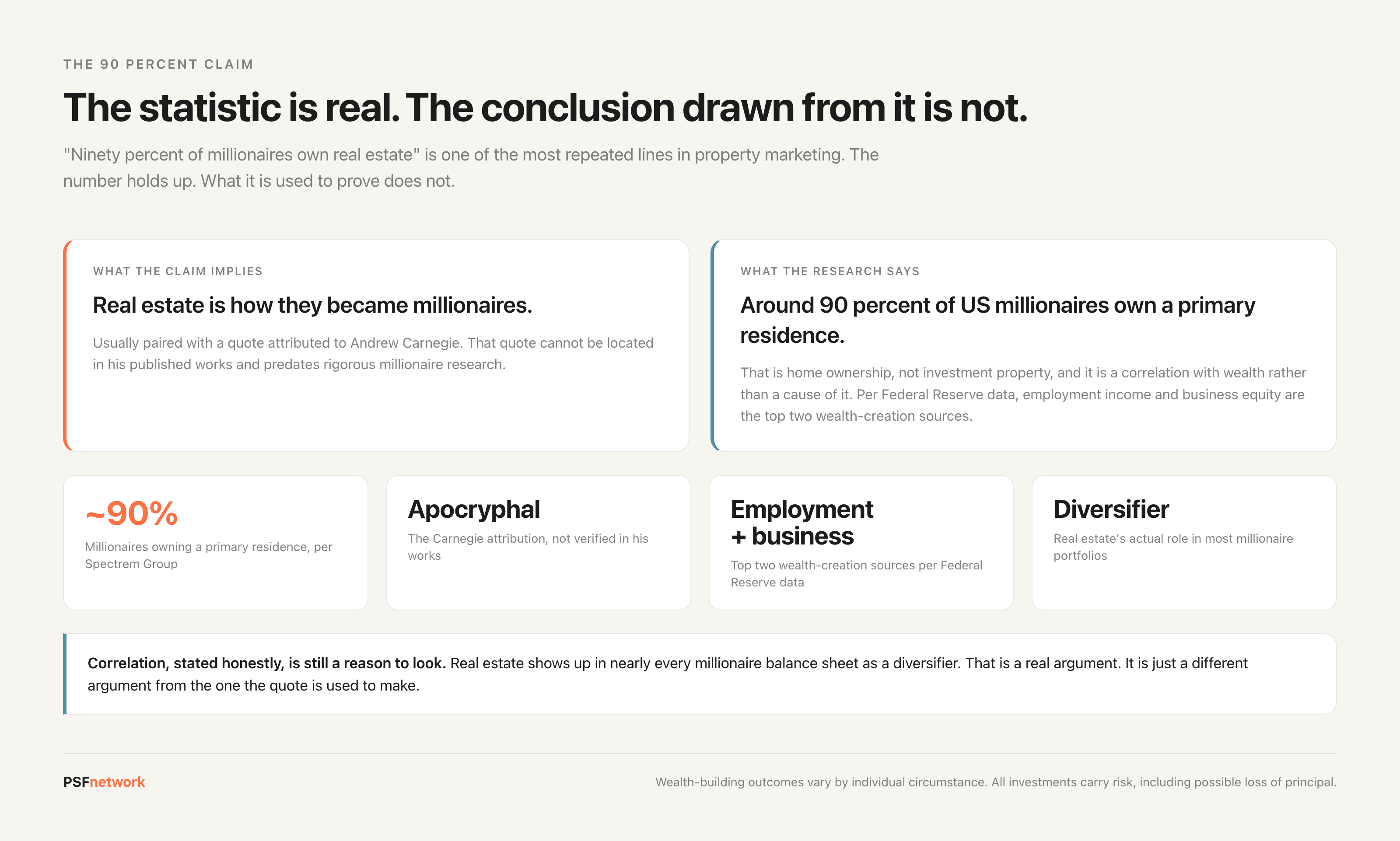
The "90 percent of millionaires own real estate" claim is widely cited but commonly misread. The most-referenced study (Spectrem Group) found that around 90 percent of US millionaires own a primary residence, not that real estate is how they became millionaires. The popular quote attributed to Andrew Carnegie ("Ninety percent of all millionaires become so through owning real estate") cannot be located in his published works and predates rigorous millionaire research. The honest reading: real estate is correlated with wealth, and primary-residence ownership is near-universal at the millionaire level. But for most US millionaires, the primary wealth-creation engine is employment and business equity, not investment property.
The "90 percent of millionaires own real estate" claim is widely cited but commonly misread. The most-referenced study (Spectrem Group) found that around 90 percent of US millionaires own a primary residence, not that real estate is how they became millionaires. The popular quote attributed to Andrew Carnegie ("Ninety percent of all millionaires become so through owning real estate") cannot be located in his published works and predates rigorous millionaire research. The honest reading: real estate is correlated with wealth, and primary-residence ownership is near-universal at the millionaire level. But for most US millionaires, the primary wealth-creation engine is employment and business equity, not investment property.
The line gets quoted like scripture: 90 percent of millionaires own real estate, and they supposedly got rich through it, straight from Andrew Carnegie. He never wrote it. Nobody can find it in his books, his autobiography, or a single recorded speech. What survives fact-checking is a quieter, more useful statistic, and it says something different about how the rich actually use property.
Quick Answer (60 seconds)
The claim that 90 percent of millionaires own real estate is true, but only in a narrow way. So do millionaires invest in real estate? Almost all of them own a home, which is where the famous line comes from: roughly nine in ten hold a primary residence. The more useful question is how millionaires invest in real estate beyond the house they live in. But owning a home is not the same as getting rich through real estate. The honest reading: for most US millionaires the money came from income, long-term investing, and a business, with real estate as one steady, income-producing piece of the mix. That distinction matters, because it points to how you should hold real estate. Not as a lottery ticket, but as a diversified, income-oriented slice, which is exactly the slice that has become reachable for far less money than it used to take.
All investments carry risk including loss of principal. Outcomes vary by individual circumstance.
The slogan sticks because it folds two different facts into one tidy line. The more useful question is not whether millionaires own real estate, but how they actually invest in it. Answer that, and you get a practical blueprint instead of a motivational poster.
Where the claim comes from
Two sources collapsed into one phrase. The first is the Carnegie quote, which cannot be found in The Gospel of Wealth, his autobiography, or any recorded address. It surfaces in mid-20th-century motivational writing, decades after he died in 1919, and spread through repetition rather than evidence.
The second is real survey research showing most millionaires own a home. True enough. But "owns a home" and "got rich through property" are very different claims, and only the first holds up. Tellingly, several major millionaire studies, including Spectrem Group's, leave the primary residence out of net worth entirely. They treat the home as a place to live, not the engine of the fortune.
How millionaires actually invest in real estate
Per the Federal Reserve Survey of Consumer Finances and large wealth studies, the typical millionaire holds a primary residence, retirement accounts, private business equity, securities, and some investment real estate. How millionaires invest in real estate, looked at closely, is as one slice of a diversified portfolio, not its foundation. The home equity is near universal, but a home you live in is a cost, not an investment.
The mix shifts with wealth. Around $1 million to $3 million, the house is often the biggest single asset. Higher up, business equity and stocks take over, while investment real estate stays meaningful without ever dominating. Goals matter too: millionaire real estate investing skews heavier toward property when income is the aim, since rentals are built to pay cash.
There is a quiet lesson in that last point. The investors who lean hardest on real estate are usually after income, not a moonshot, and they get it from property that actually produces rent. That is the model worth copying, and it no longer requires a down payment and a mortgage in your name.
Path to wealth, or result of wealth?
So does real estate create wealth? Both answers are true, and the direction is the point. For a few people it is the cause: they built a development business or bought rentals early and aggressively. For most millionaires it is the result. Higher income bought the house first, then an income-producing property later. The link between real estate and wealth is real; the arrow points different ways for different people.
You cannot reliably skip the wealth-building step by buying property. Real estate can build wealth, and often has. But the slogan hides the slow truth underneath it: high income, a high savings rate, and decades of compounding across several assets, with real estate as one durable, cash-flowing part.
What it means for you
Three takeaways. Real estate is a genuine diversifier worth owning, and if your goal is income, millionaire real estate investing patterns suggest it can fairly carry more weight. The 90 percent figure is a diversification data point, not a blueprint, so there is no reason to overload on it. And the order matters: millionaires bought a home first and added income property later, but you no longer have to wait that long to start the second part.
The sequence is unglamorous. Build emergency savings, capture the retirement match, hold a diversified equity base, then add real estate in a weight that fits your goals. What has changed is the entry price. You once needed a full property and a loan; now you can buy a fractional stake in a specific, rented building for the price of a nice dinner, and collect your share of the income while you hold it.
The easiest ways to start small
Three routes, each doing a different job. A REIT ETF like VNQ or IYR gives instant, liquid exposure to a basket of real estate, with a minimum as low as one share, best if you want flexibility and an easy exit. Real estate debt platforms let you lend to projects for interest over a set term, best if you want scheduled cash flow with a defined end date. And single-property fractional ownership lets you buy a piece of one specific, income-producing building and collect a proportional share of the rent, reported on a K-1 (a tax form used by pass-through investment entities), best if your goal is passive income from real property you can actually point to.
That third route is where PSFnetwork fits: it sells mortgage-free property by the square foot, under Regulation A, so non-accredited investors can buy a visible piece of a specific building and collect its rent. A good slogan rarely makes a good strategy, but matching the structure to your goal usually does.
See how per-square-foot ownership works ›
In summary, the 90 percent figure sticks because it flatters a simple story: buy real estate, get rich. The data tells a slower one. Homeownership really is near universal among millionaires, but that reflects wealth they already had more than wealth real estate made. The Carnegie line behind the slogan was never his. And the surveys measure who owns a home, not what built the fortune.
What survives the myth is the genuinely useful part. The millionaires who hold the most real estate tend to hold it for income, in property that pays rent, as one piece of a diversified portfolio. That model used to demand a large down payment and a mortgage. It no longer does. Fractional ownership lets you buy a share of a specific, income-producing building today, on a much smaller budget. Start from the evidence, size real estate to your own goals, and treat it as the steady, cash-flowing slice the data says it really is.
If that fits how you want to invest, PSFnetwork's offerings are made only under qualified offering documents. Review the offering circular and risk factors before you invest.
Sources:
Federal Reserve, Survey of Consumer Finances. https://www.federalreserve.gov/econres/scfindex.htm
Ramsey Solutions, The National Study of Millionaires. https://www.ramseysolutions.com/retirement/the-national-study-of-millionaires-research
Nasdaq, Unmasking the Real Estate Wealth Myth. https://www.nasdaq.com/articles/unmasking-the-real-estate-wealth-myth
SEC Office of Investor Education (investor.gov), Real Estate Investment Trusts (REITs). https://www.investor.gov/introduction-investing/investing-basics/investment-products/real-estate-investment-trusts-reits
Disclaimer: This article is for educational purposes only and does not constitute financial, investment, legal, or tax advice. PSFnetwork investments involve risk, including potential loss of principal. Past performance does not guarantee future returns. Investments are offered through PSF Capital LLC under Reg A+ exemptions. Please review the offering circular and consult a qualified financial advisor before making investment decisions.
The line gets quoted like scripture: 90 percent of millionaires own real estate, and they supposedly got rich through it, straight from Andrew Carnegie. He never wrote it. Nobody can find it in his books, his autobiography, or a single recorded speech. What survives fact-checking is a quieter, more useful statistic, and it says something different about how the rich actually use property.
Quick Answer (60 seconds)
The claim that 90 percent of millionaires own real estate is true, but only in a narrow way. So do millionaires invest in real estate? Almost all of them own a home, which is where the famous line comes from: roughly nine in ten hold a primary residence. The more useful question is how millionaires invest in real estate beyond the house they live in. But owning a home is not the same as getting rich through real estate. The honest reading: for most US millionaires the money came from income, long-term investing, and a business, with real estate as one steady, income-producing piece of the mix. That distinction matters, because it points to how you should hold real estate. Not as a lottery ticket, but as a diversified, income-oriented slice, which is exactly the slice that has become reachable for far less money than it used to take.
All investments carry risk including loss of principal. Outcomes vary by individual circumstance.
The slogan sticks because it folds two different facts into one tidy line. The more useful question is not whether millionaires own real estate, but how they actually invest in it. Answer that, and you get a practical blueprint instead of a motivational poster.
Where the claim comes from
Two sources collapsed into one phrase. The first is the Carnegie quote, which cannot be found in The Gospel of Wealth, his autobiography, or any recorded address. It surfaces in mid-20th-century motivational writing, decades after he died in 1919, and spread through repetition rather than evidence.
The second is real survey research showing most millionaires own a home. True enough. But "owns a home" and "got rich through property" are very different claims, and only the first holds up. Tellingly, several major millionaire studies, including Spectrem Group's, leave the primary residence out of net worth entirely. They treat the home as a place to live, not the engine of the fortune.
How millionaires actually invest in real estate
Per the Federal Reserve Survey of Consumer Finances and large wealth studies, the typical millionaire holds a primary residence, retirement accounts, private business equity, securities, and some investment real estate. How millionaires invest in real estate, looked at closely, is as one slice of a diversified portfolio, not its foundation. The home equity is near universal, but a home you live in is a cost, not an investment.
The mix shifts with wealth. Around $1 million to $3 million, the house is often the biggest single asset. Higher up, business equity and stocks take over, while investment real estate stays meaningful without ever dominating. Goals matter too: millionaire real estate investing skews heavier toward property when income is the aim, since rentals are built to pay cash.
There is a quiet lesson in that last point. The investors who lean hardest on real estate are usually after income, not a moonshot, and they get it from property that actually produces rent. That is the model worth copying, and it no longer requires a down payment and a mortgage in your name.
Path to wealth, or result of wealth?
So does real estate create wealth? Both answers are true, and the direction is the point. For a few people it is the cause: they built a development business or bought rentals early and aggressively. For most millionaires it is the result. Higher income bought the house first, then an income-producing property later. The link between real estate and wealth is real; the arrow points different ways for different people.
You cannot reliably skip the wealth-building step by buying property. Real estate can build wealth, and often has. But the slogan hides the slow truth underneath it: high income, a high savings rate, and decades of compounding across several assets, with real estate as one durable, cash-flowing part.
What it means for you
Three takeaways. Real estate is a genuine diversifier worth owning, and if your goal is income, millionaire real estate investing patterns suggest it can fairly carry more weight. The 90 percent figure is a diversification data point, not a blueprint, so there is no reason to overload on it. And the order matters: millionaires bought a home first and added income property later, but you no longer have to wait that long to start the second part.
The sequence is unglamorous. Build emergency savings, capture the retirement match, hold a diversified equity base, then add real estate in a weight that fits your goals. What has changed is the entry price. You once needed a full property and a loan; now you can buy a fractional stake in a specific, rented building for the price of a nice dinner, and collect your share of the income while you hold it.
The easiest ways to start small
Three routes, each doing a different job. A REIT ETF like VNQ or IYR gives instant, liquid exposure to a basket of real estate, with a minimum as low as one share, best if you want flexibility and an easy exit. Real estate debt platforms let you lend to projects for interest over a set term, best if you want scheduled cash flow with a defined end date. And single-property fractional ownership lets you buy a piece of one specific, income-producing building and collect a proportional share of the rent, reported on a K-1 (a tax form used by pass-through investment entities), best if your goal is passive income from real property you can actually point to.
That third route is where PSFnetwork fits: it sells mortgage-free property by the square foot, under Regulation A, so non-accredited investors can buy a visible piece of a specific building and collect its rent. A good slogan rarely makes a good strategy, but matching the structure to your goal usually does.
See how per-square-foot ownership works ›
In summary, the 90 percent figure sticks because it flatters a simple story: buy real estate, get rich. The data tells a slower one. Homeownership really is near universal among millionaires, but that reflects wealth they already had more than wealth real estate made. The Carnegie line behind the slogan was never his. And the surveys measure who owns a home, not what built the fortune.
What survives the myth is the genuinely useful part. The millionaires who hold the most real estate tend to hold it for income, in property that pays rent, as one piece of a diversified portfolio. That model used to demand a large down payment and a mortgage. It no longer does. Fractional ownership lets you buy a share of a specific, income-producing building today, on a much smaller budget. Start from the evidence, size real estate to your own goals, and treat it as the steady, cash-flowing slice the data says it really is.
If that fits how you want to invest, PSFnetwork's offerings are made only under qualified offering documents. Review the offering circular and risk factors before you invest.
Sources:
Federal Reserve, Survey of Consumer Finances. https://www.federalreserve.gov/econres/scfindex.htm
Ramsey Solutions, The National Study of Millionaires. https://www.ramseysolutions.com/retirement/the-national-study-of-millionaires-research
Nasdaq, Unmasking the Real Estate Wealth Myth. https://www.nasdaq.com/articles/unmasking-the-real-estate-wealth-myth
SEC Office of Investor Education (investor.gov), Real Estate Investment Trusts (REITs). https://www.investor.gov/introduction-investing/investing-basics/investment-products/real-estate-investment-trusts-reits
Disclaimer: This article is for educational purposes only and does not constitute financial, investment, legal, or tax advice. PSFnetwork investments involve risk, including potential loss of principal. Past performance does not guarantee future returns. Investments are offered through PSF Capital LLC under Reg A+ exemptions. Please review the offering circular and consult a qualified financial advisor before making investment decisions.
Sources
Disclaimer
This article is for educational purposes only and does not constitute financial, investment, legal, or tax advice. Investments involve risk, including potential loss of principal. Past performance does not guarantee future returns. Investments are offered through PSFnetwork MasterSeries LLC under Reg A. Please review the offering circular and consult a qualified financial advisor before making investment decisions.

Ready When You are
Start from square one
Browse fractional properties across US metros. No accreditation required.
Ready When You are
Start from square one
Browse fractional properties across US metros. No accreditation required.
Keep Reading





Important information
© 2026 PSFnetwork. All rights reserved.
Important information
© 2026 PSFnetwork. All rights reserved.